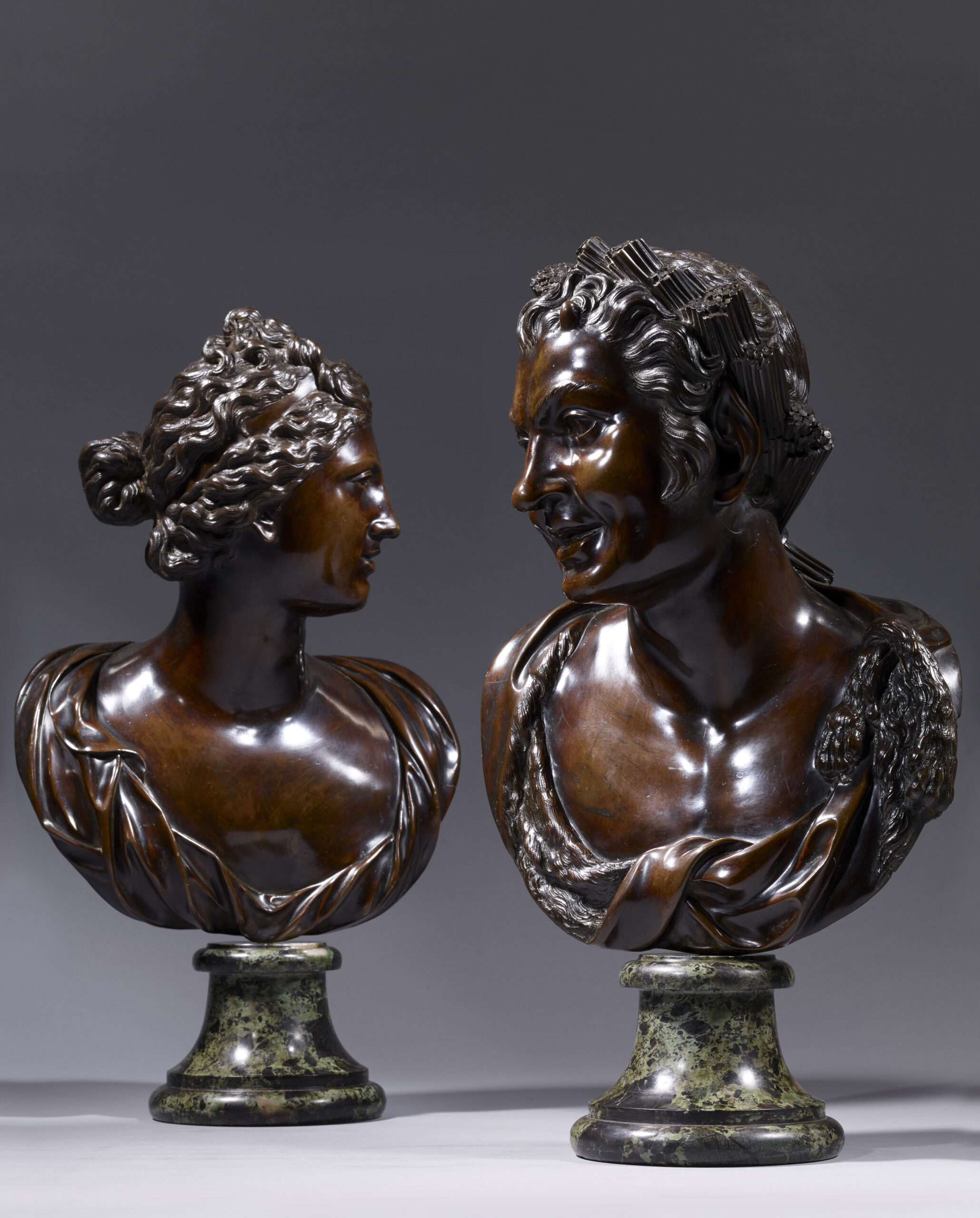
Bronze with brownish-black patina; marble (piedouches).
Bustes: H. 44 cm. (17 ¼ in.); W. 33 cm. (12 ½ in.).
Piedouches: H. 13 cm. (5 in.); Total H. : 57 cm. (22 ½ in.).
PROVENANCE: collection of Louis-Antoine Crozat (1699-1770), Baron de Thiers, in his private mansion on the Place Vendôme, the Hôtel d’Evreux, n°. 19; lot n°. 355 of his post-mortem inventory drawn up on 22nd December 1770, seven days after his death; auction of the “cabinet de feu M. Crozat, Baron de Thiers” by Pierre Remy (1715 (?)-1797 (? )), Paris, between 26th February and 27th March 1772, lot n°. 920; collection of Claude-Pierre-Maximilien de Radix de Sainte-Foy (1736-1810), trésorier de la Marine in 1764, and superintendent of the Comte d’Artois, its auction in Paris by Jean-Baptiste-Pierre Lebrun (1748-1813), 22nd April 1782 & following days, lot n°. 28; bought at the auction by Jacques Langlier or Lenglier (1730? -181?), picture dealer and expert, then resold by Lebrun, 3 December 1782, lot n°. 131; acquired at the auction by Pierre-François Basan (1723-1797), engraver, publisher and print dealer;possibly the collection of Baron Pieter Nicolaas Van Hoorn Van Vlooswijck (1742-1809), in his hôtel located at 34 rue d’Enfer, Paris; auctioned in situ in Paris by Lebrun,22nd November 1809, lot n°. 31.
LITERATURE on Robert Le Lorrain: Michèle Beaulieu, Robert Le Lorrain, 1666-1743, Paris, Arthena, 1982; Guilhem Scherf, “Robert Le Lorrain”, Bronzes français de la Renaissance au Siècle des lumières, Geneviève Bresc-Bautier & Guilhem Scherf (eds.), Paris, 2008, p. 416.
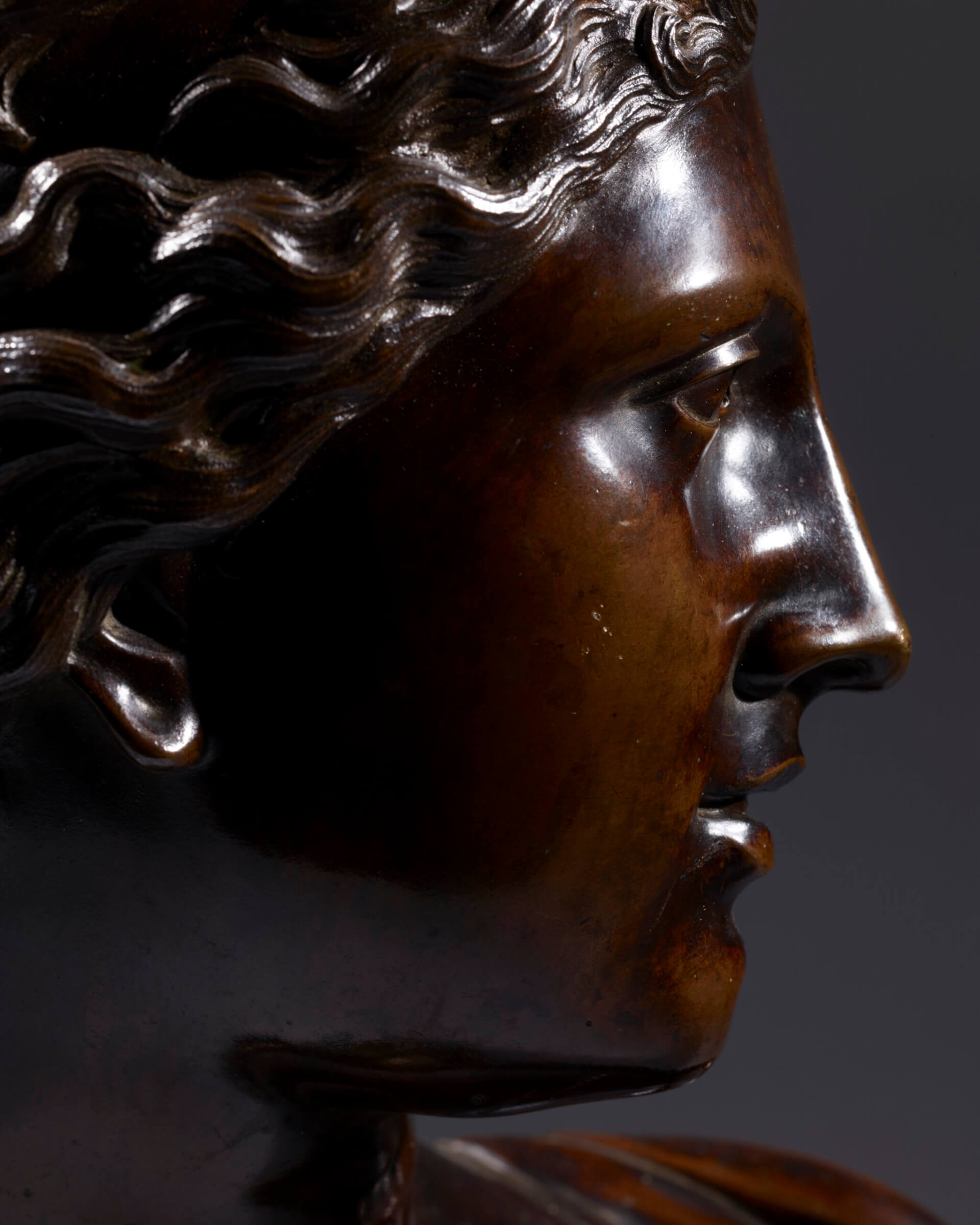
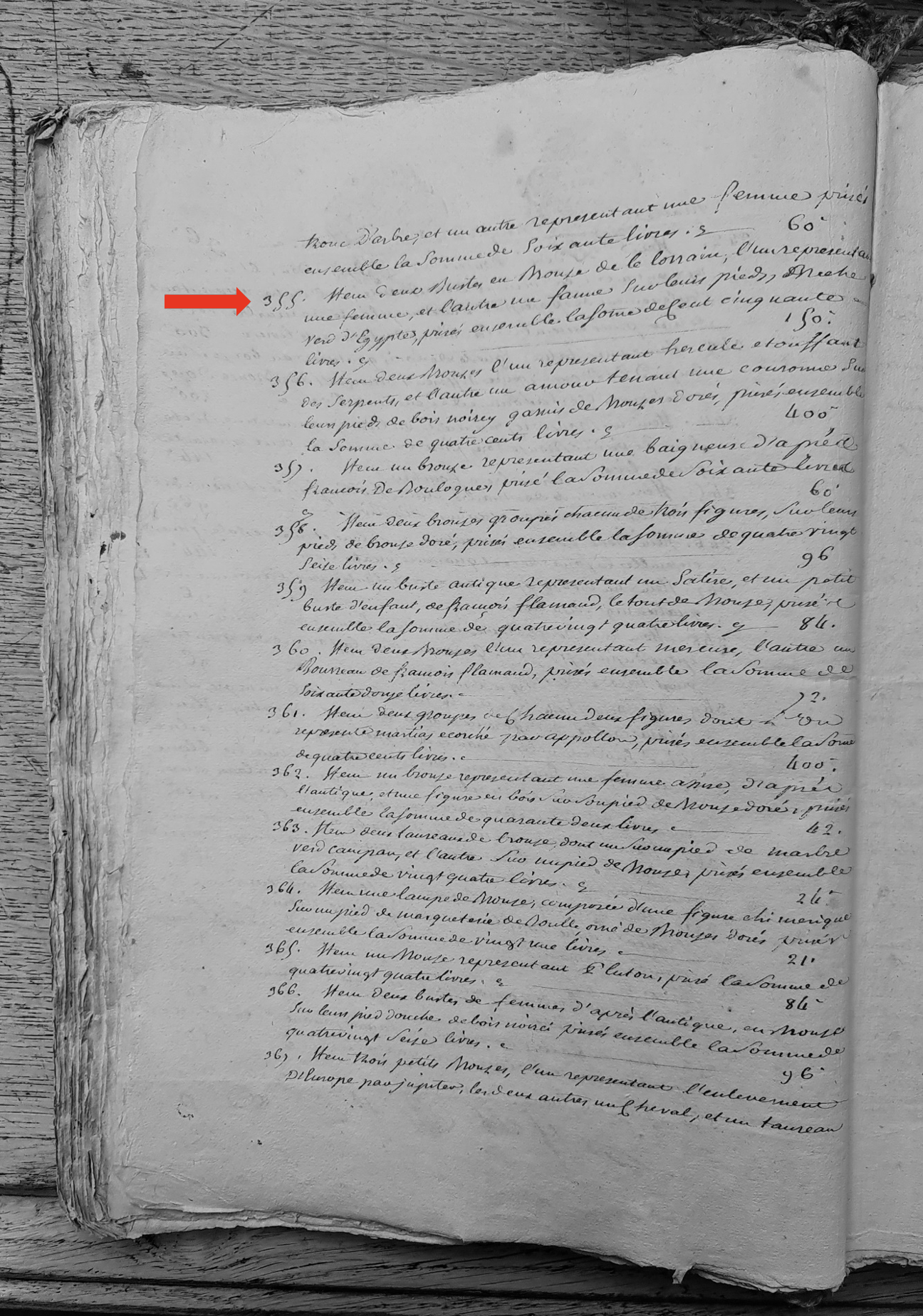
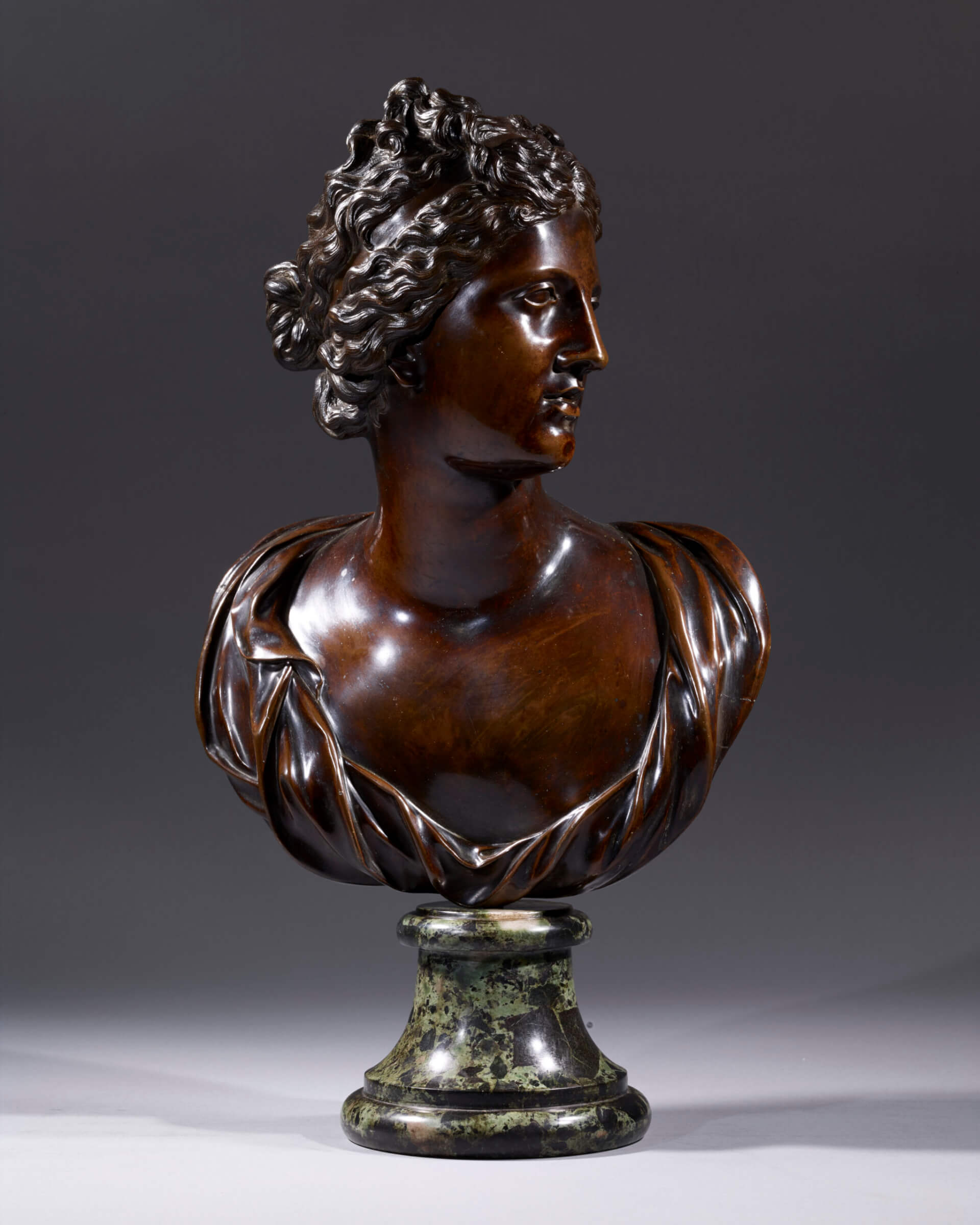
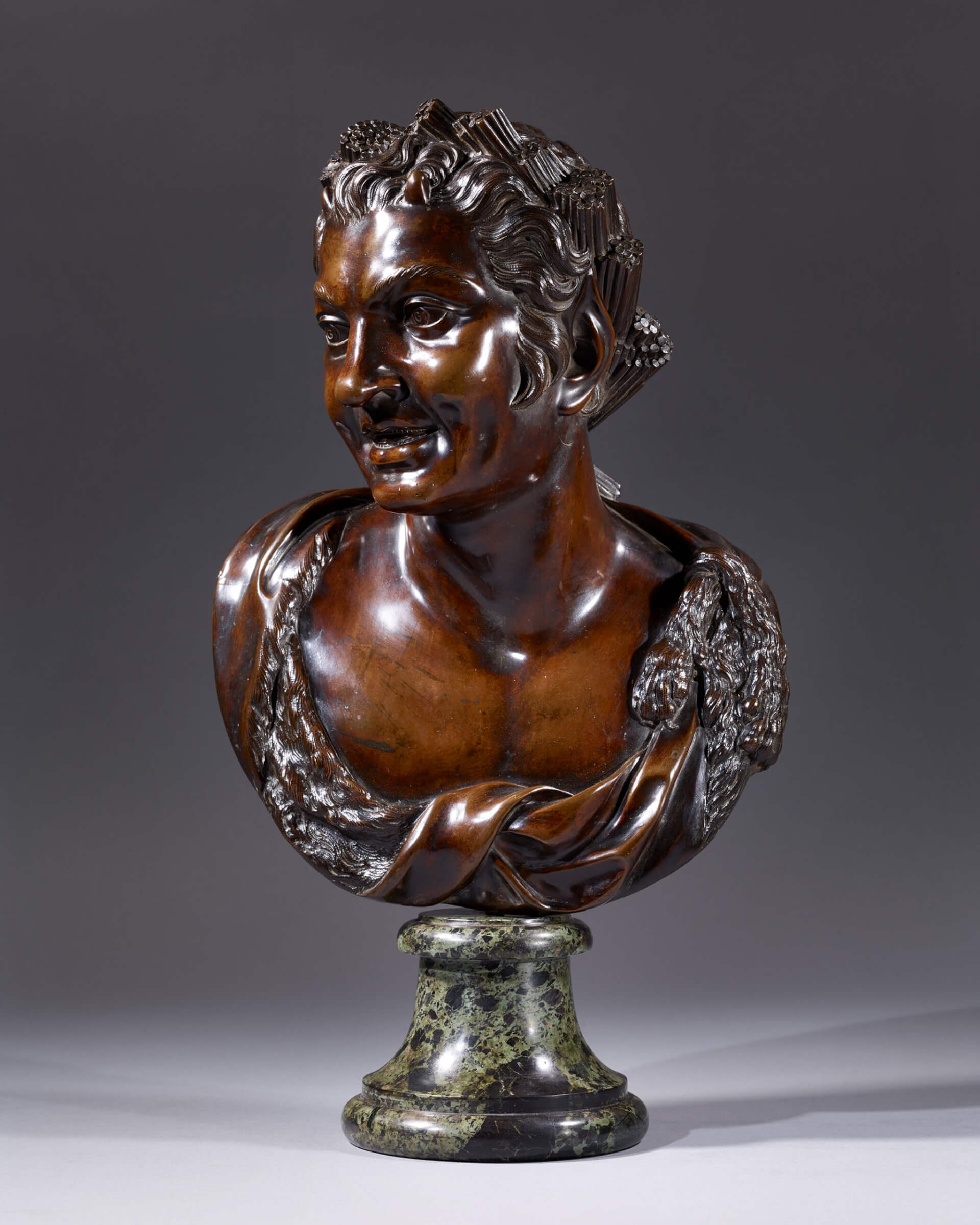
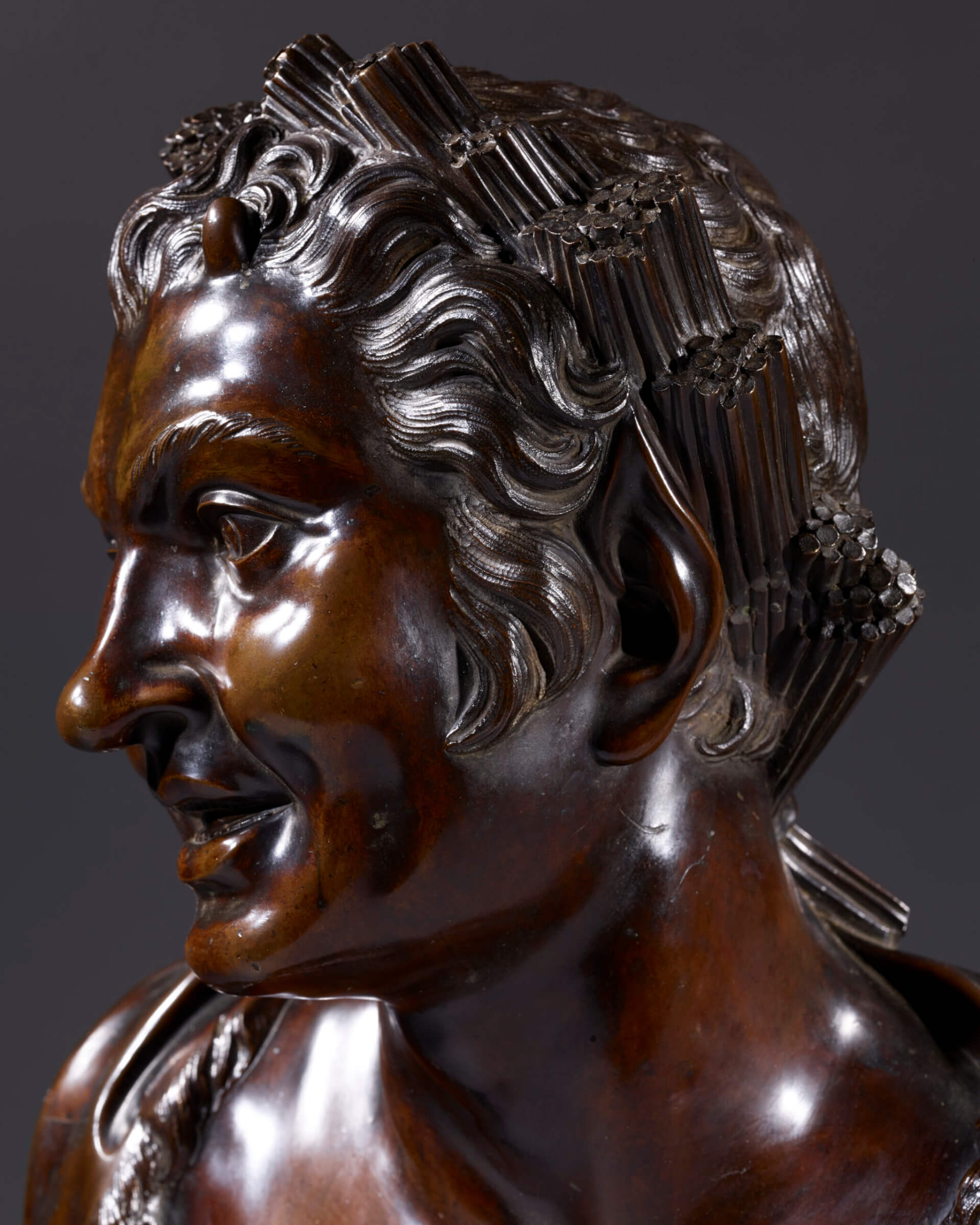
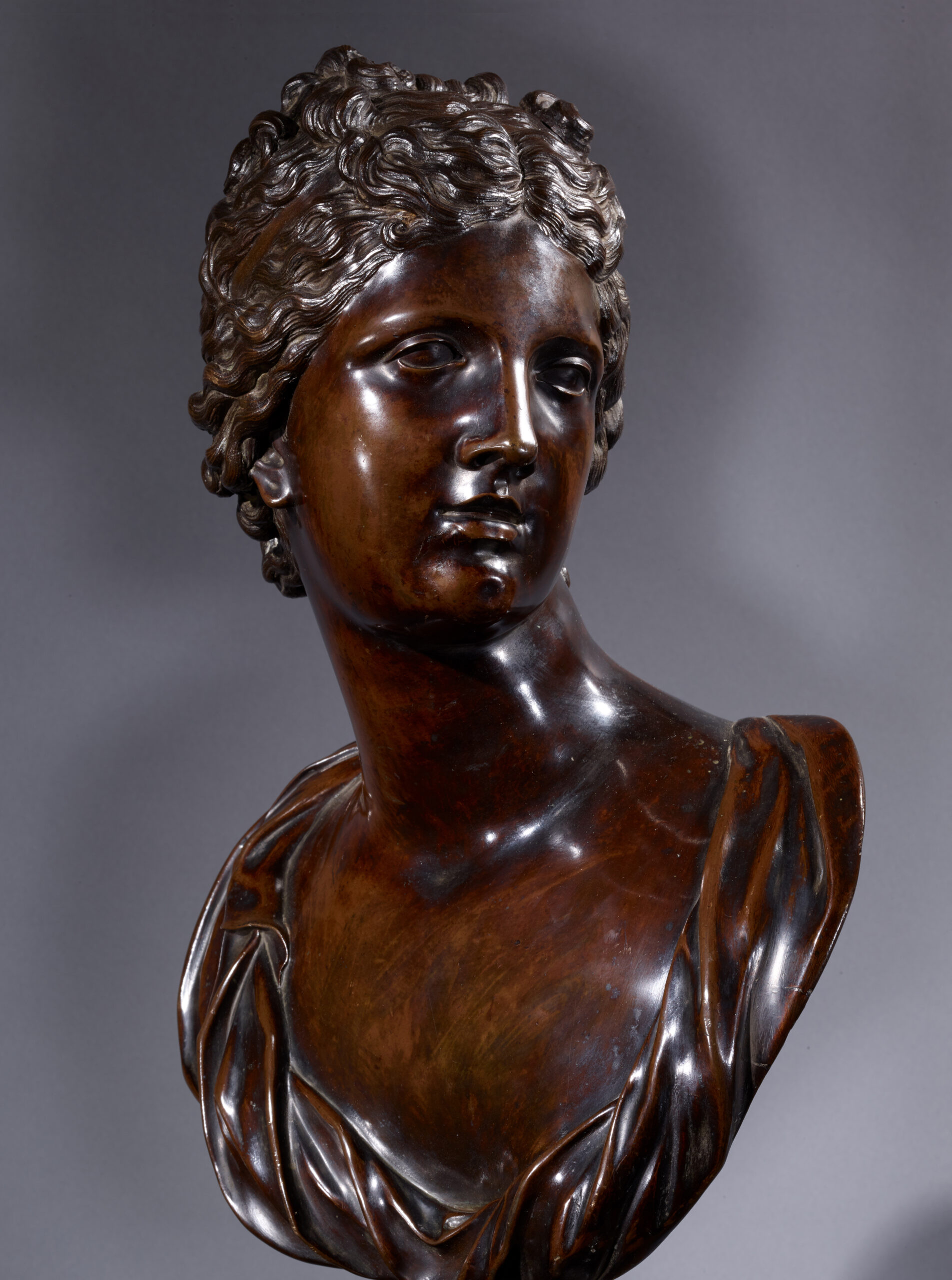
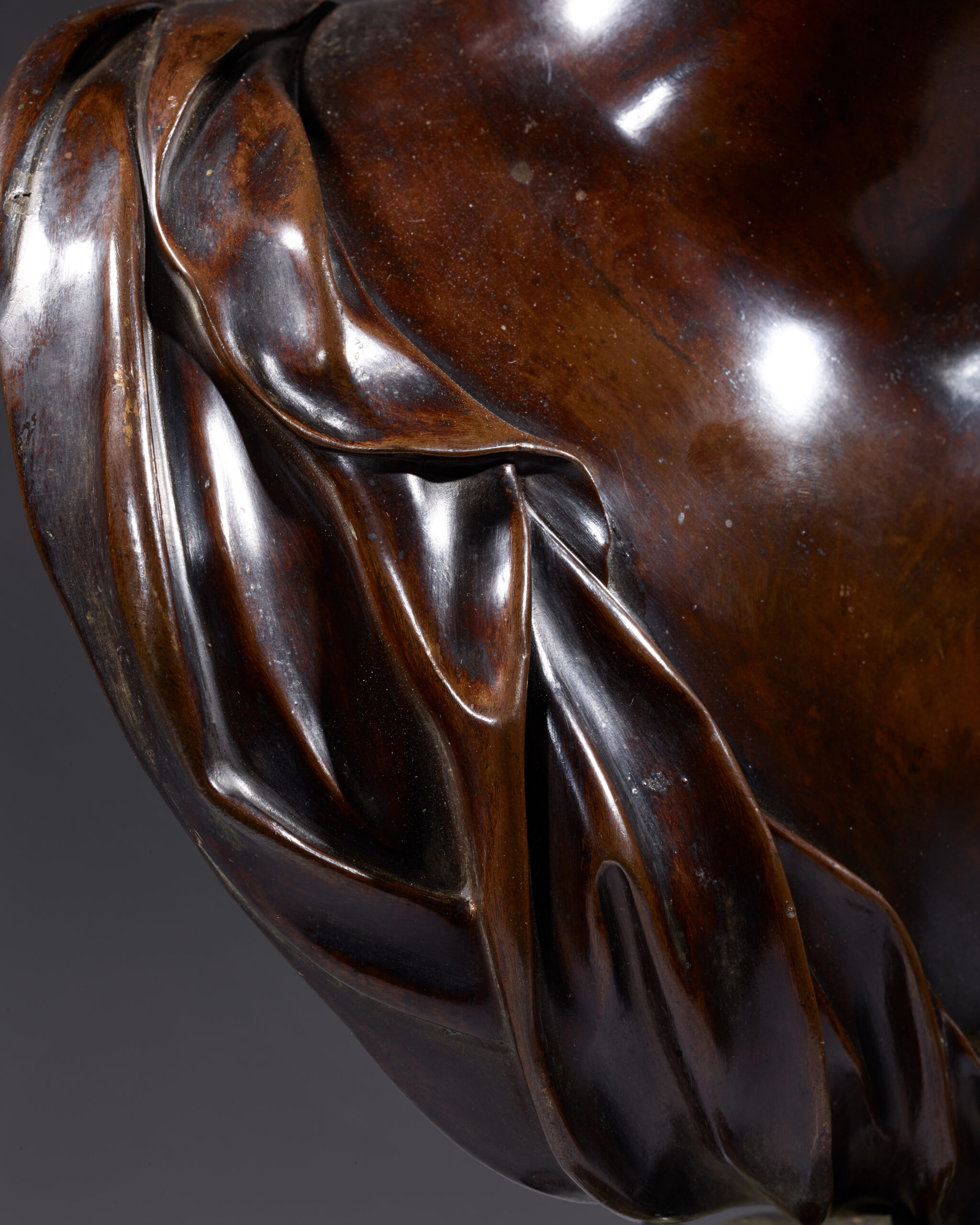
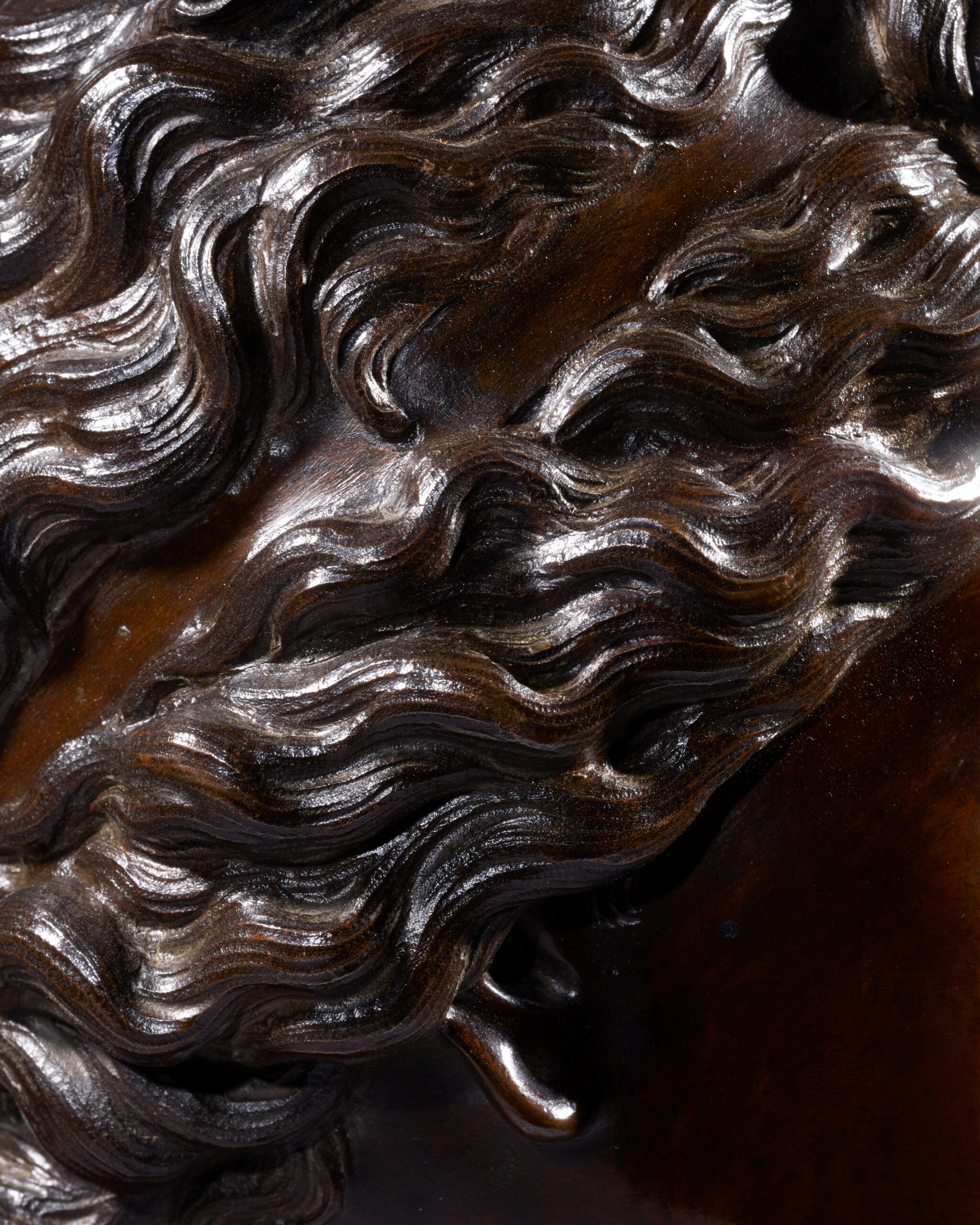
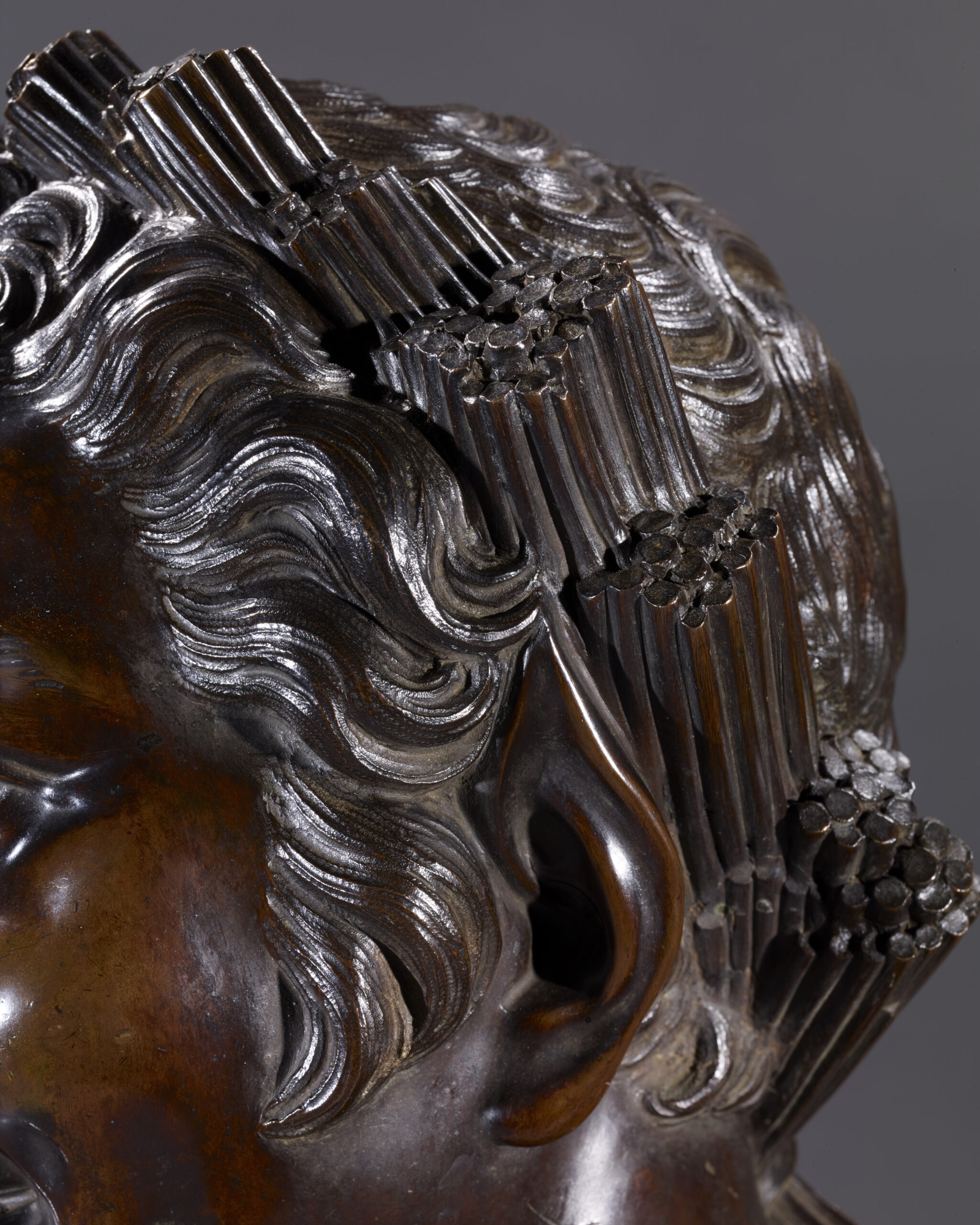
These bronze busts, dated to circa 1695-1705, very finely chiselled and with a beautiful brownish-black patina, one representing the Venus de’ Medici, and the second a Faun with a particularly expressive, smiling face and a headdress enhanced by a pine wreath, correspond, with the exception of their piedouches, to “two bronze busts by Le Lorrain” mentioned in the post-mortem inventory of Louis-Antoine Crozat (1699-1770), baron de Thiers, drawn up on 22nd December 1770, i.e. seven days after his death, in his private mansion on Place Vendôme, the Hôtel d’Evreux, located at n°. 19 Place Vendôme: “355. Item two bronze busts by Le Lorrain, one representing a woman and the other a faun on their feet of Egyptian green marble, valued together at the amount of one hundred and fifty livres. Cy…150”.
The model for the bust of the Faun, attributed here for the first time to Robert Le Lorrain (1666-1743), based on an antique precedent from the collection of François Girardon (1628-1715), which we shall analyse below, had traditionally been attributed to the Florentine sculptor Massimiliano Soldani-Benzi (1656-1740) since the publication of a study in 1962 by the German art historian Klaus Lankheit.
A copy of this model was successively part of the Steinitz collection in Paris and then of Daniel Katz in London; and a second, but with a round neck and without any drapery, is kept in Chapel Hill, USA, in the collections of the Ackland Art Museum, The University of North Carolina, donated by the Ackland Associates and Ackland Fund.
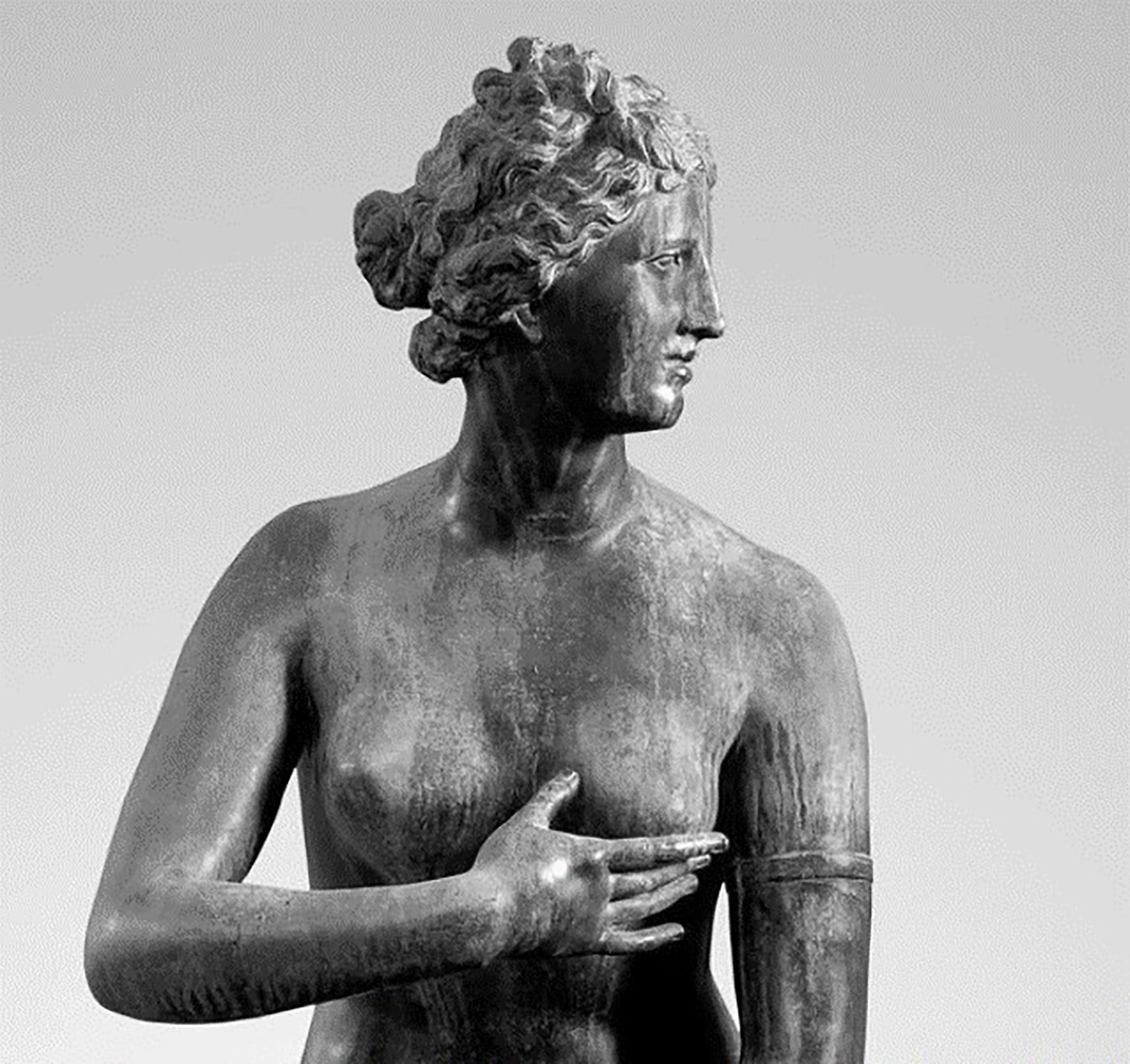
The model for the bust of the Venus de’ Medici was well known in France at the end of the 17th century, and circa 1685, the year after Le Lorrain was admitted to his workshop as a pupil, Girardon, as evidenced by the accounts of the Bâtiments du Roi, provided the wax and plaster models for the large full-length Venus de’ Medici in the Château de Versailles (inv. MR 3292/MV 8428), the pendant to an Adonis for which he also provided the models. Cast by Jean-Balthasar Keller (1638-1702) in 1685-1687, the two bronzes were originally placed on the parterre of the Orangerie of the château, to the west of the central alley, before eventually being sent to the château of Marly, where they were recorded in the inventory of 1695.
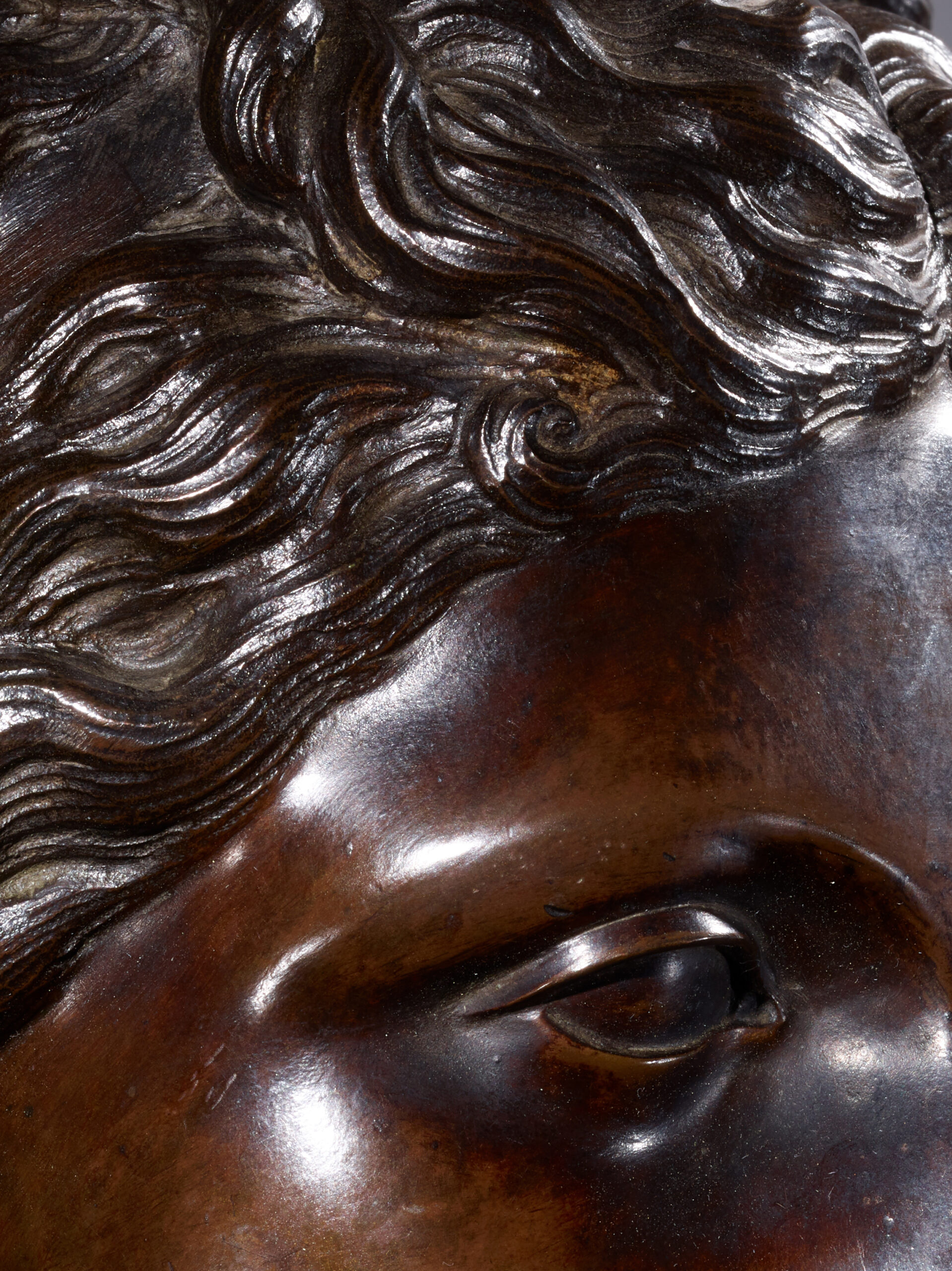
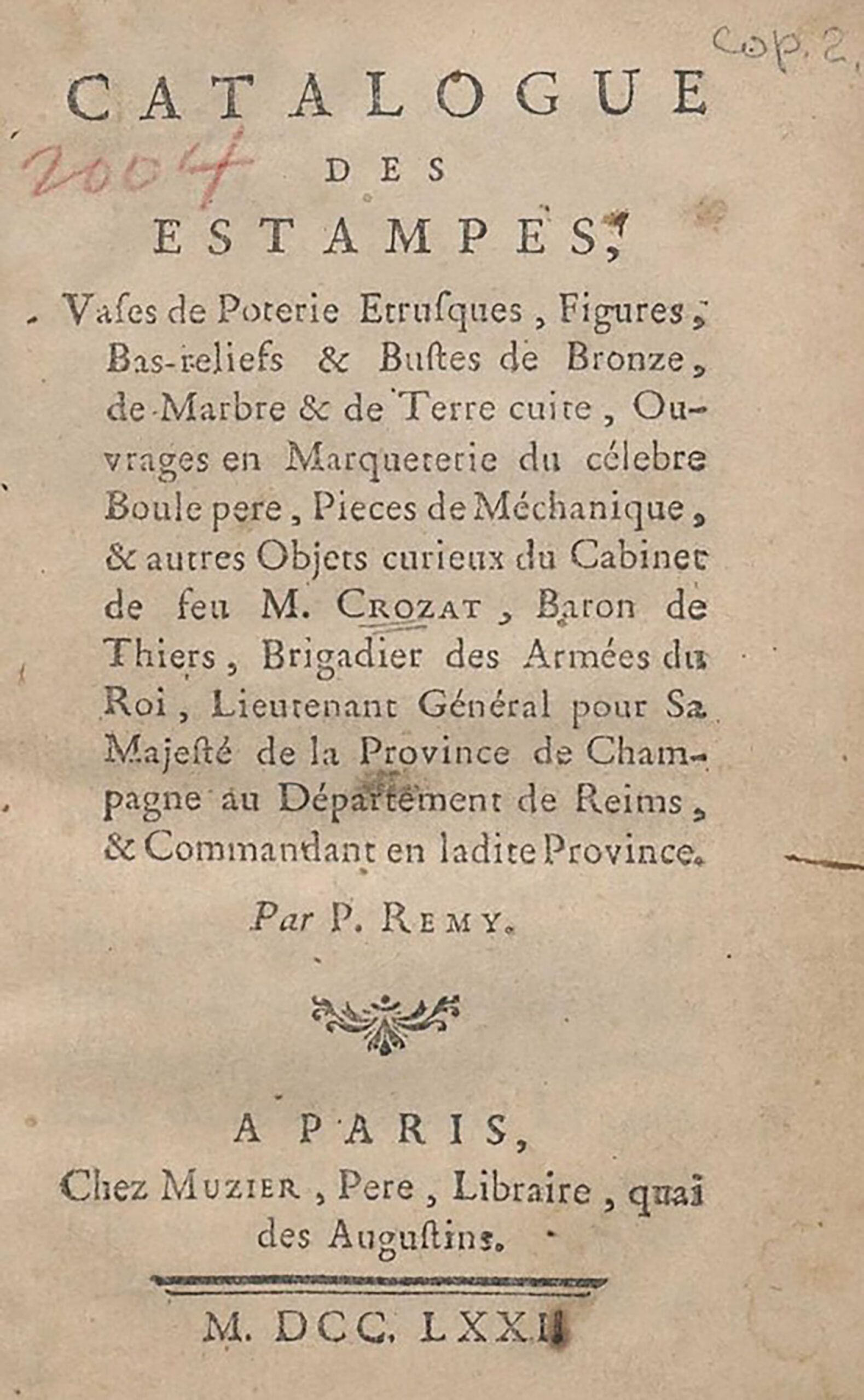
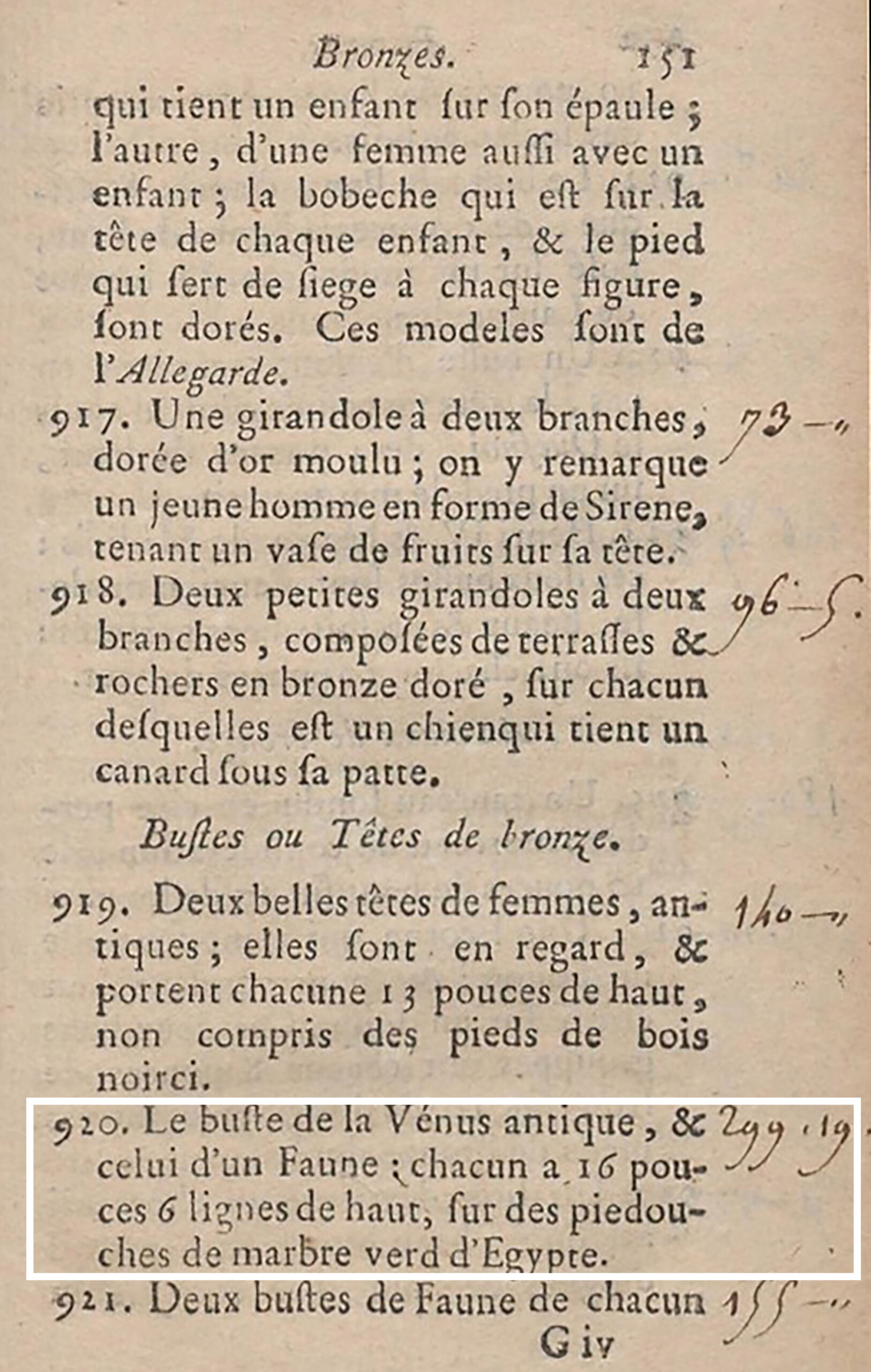
To the best of our knowledge, the two busts of the baron de Thiers are the only instances of the pairing of the bust of the Venus de’ Medici with that of the Faun that we have listed in eighteenth-century auction catalogues. They were auctioned by Pierre Remy (1715 (?)-1797 (?)), at the time of the sale of the “cabinet of the late M. Crozat, Baron de Thiers”, which took place in Paris between 26th February and 27th March 1772; they are described in the chapter on “Bronzes” with additional particulars and, most importantly, their height without the piedouche: “920. The bust of the antique Venus, & that of a Faun: each 16 inches 6 lines in height [44.65 cm., i.e. the exact height of the two busts under consideration here without their piedouche], on Egyptian green marble piedouches”. They were sold for 299 livres. Acquired at the auction or resold a little later to Claude-Pierre-Maximilien de Radix de Sainte-Foy (1736-1810), trésorier de la Marine in 1764, superintendent to the comte d’Artois and ministre plénipotentiaire to the duc des Deux-Ponts, the busts appeared in the anonymous auction of his collection by Jean-Baptiste-Pierre Lebrun (1748-1813), on 22nd April 1782 and the following days: “Bronzes […] 28 Two Busts: one representing the Venus de’ Medici, & the other the Faun: both after the antique manner, very well chiselled, & placed on sea green piedouches. Height 21 inches [56.8 cm. including the piedouche], width 12 inches [32.5 cm. therefore the precise width of the two busts studied here]”. They were bought at the auction by Jacques Langlier or Lenglier (1730?-181?), painting dealer and expert, then resold by Lebrun a few months later, on 3rd December 1782, on the occasion of an important sale of works “provenans de différens Cabinets” (from various Cabinets), but also from his own collection, forming lot n°. 131 with the same description and the same dimensions as those mentioned in the catalogue of the April auction. Pierre-François Basan (1723-1797), engraver, publisher and print dealer, acquired them for the amount of 281 livres.
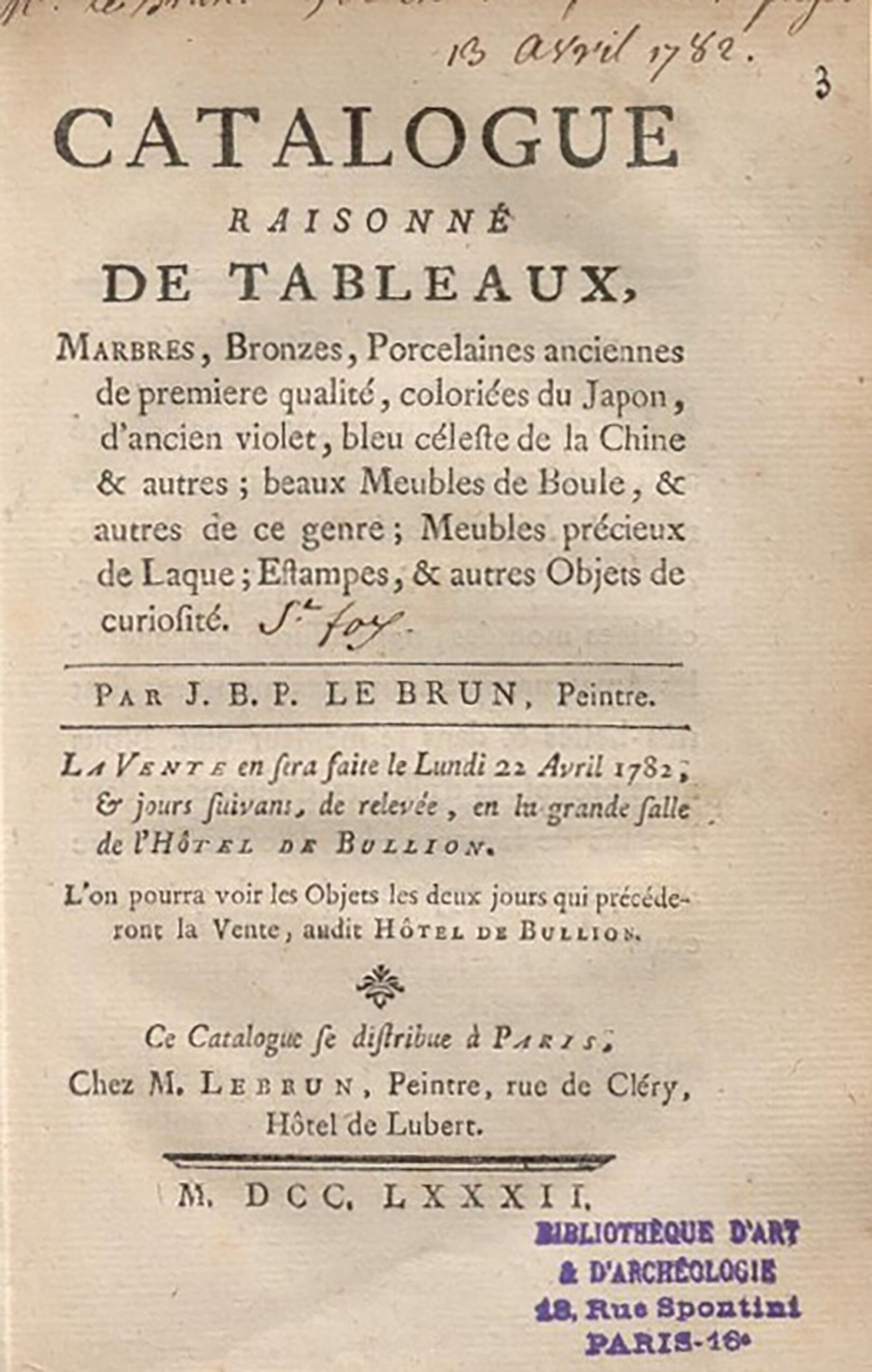
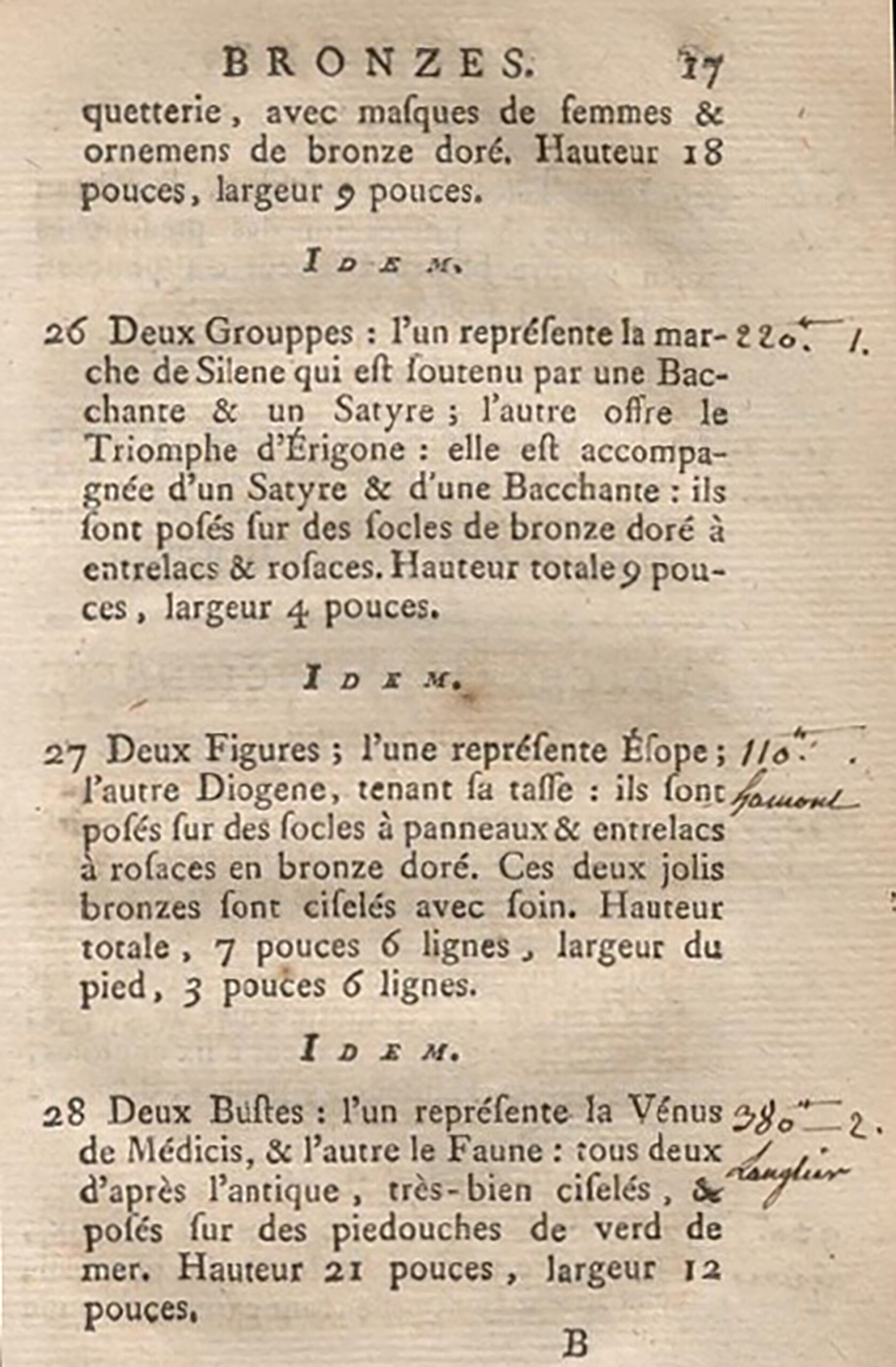
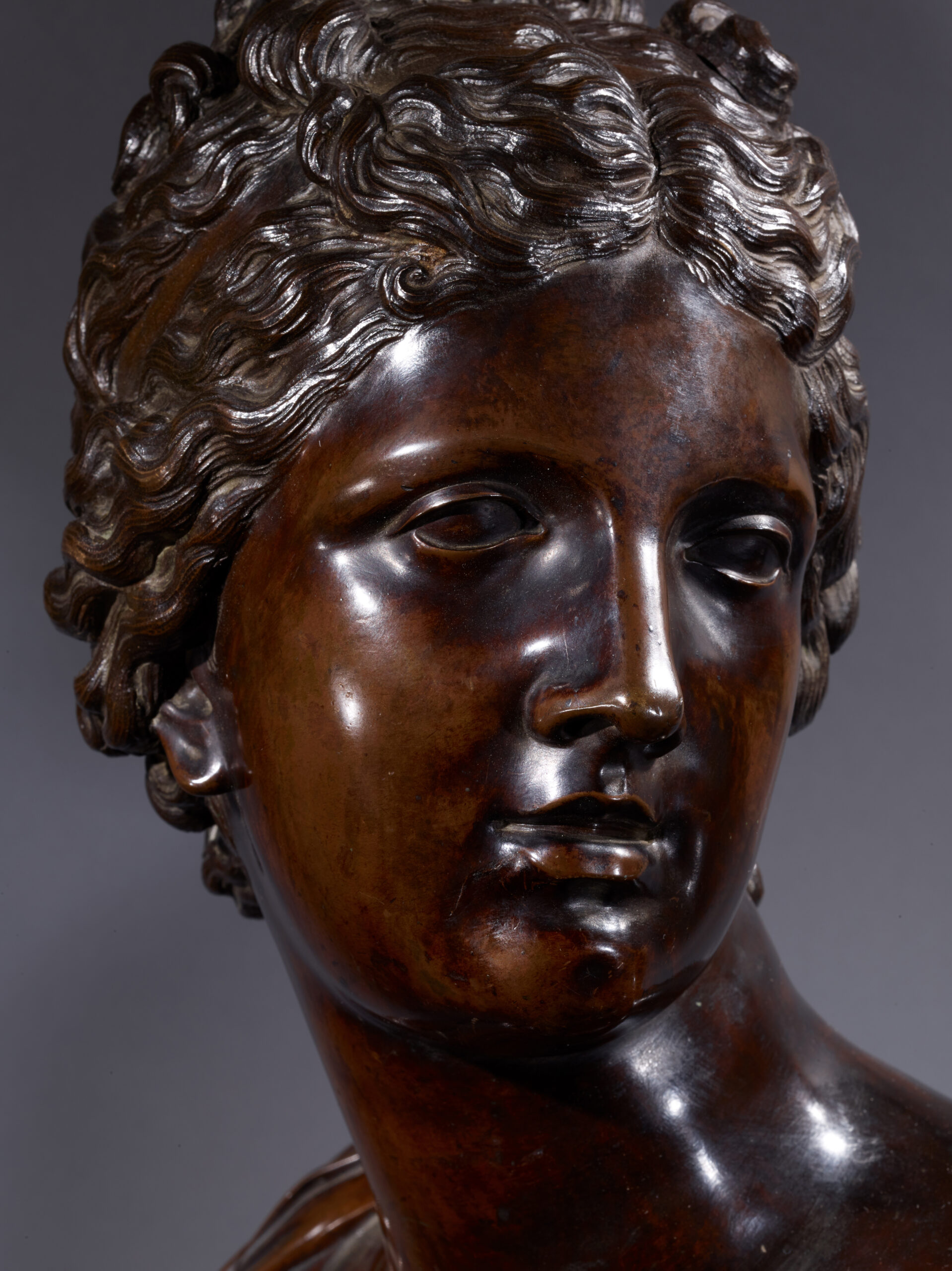
Could it not then be envisaged that he sold them to baron Pieter Nicolaas Van Hoorn Van Vlooswijck (1742-1809), a great collector and connoisseur from Amsterdam who lived in Paris, or that he might have acquired them at a later date? The baron owned in his private mansion located at 34 rue d’Enfer in Paris:
“Two bronze busts, of a charming execution: the Venus de’ Medici, the Faun with a bronze spot; on a Sienna-yellow marble piedouche.-16 in. long [43.3 cm]”, which formed lot n°. 31 of his post-mortem auction of 22nd November 1809, which took place in situ in his mansion under the ministry of Lebrun. The fact that we have not been able to identify any other lot pairing the bronze bust of the Venus de Medici with that of a Faun, both about 16 inches high without their piedouches, in 18th-century auction catalogues other than those mentioned above, allows us to raise the question here. If this proved to be the case, it would mean that the original Egyptian green marble piedouches would have been changed, which, according to the wishes and whims of dealers and collectors, may well have occurred.
We should also mention as worthy of note on two occasions, and in the successive collections of two great figures of the State, both in charge of the finances of the Kingdom, Jean-Nicolas de Boullongne (1726-1787), intendant des Finances of Louis XV in 1757, a great collector and amateur honoraire of the Académie royale de Peinture et de Sculpture since 1777, and Charles-Alexandre de Calonne (1734-1802), contrôleur général des Finances from 1783, who went into exile in London after his disgrace in 1787, the presence of a bronze bust of the Venus de’ Medici paired with a bust not of a faun but of a satyr, both placed on gilt bronze piedouches, and with a total height of 22 inches [59. 5 cm]. This is clearly the same lot that first belonged to Monsieur de Boullongne, forming n°. 252 of his post-mortem auction on 8th May 1787, under the direction of Georges and Bizet, “in his Hôtel, rue S. Honoré, vis-à-vis les Jacobins; N°. 14”: “Two busts, the Venus de’ Medici & a Satyr en pendant, on their gilded piedouche: Height, 22 inches”; then to Monsieur de Calonne, mentioned in the anonymous auction of his collection organised by Lebrun from 21st to 30th April 1788, the year after his exile: “293 Two very pleasing Busts, the Venus de’ Medici & a Satyr, on their gilded piedouche. Height 22 inches”. The two busts were bought for 281 livres by Munié, a painting dealer, whose post-mortem auction took place during the reign of Louis-Philippe, between 11th and 16th November 1839 in Paris. The two busts were not included.
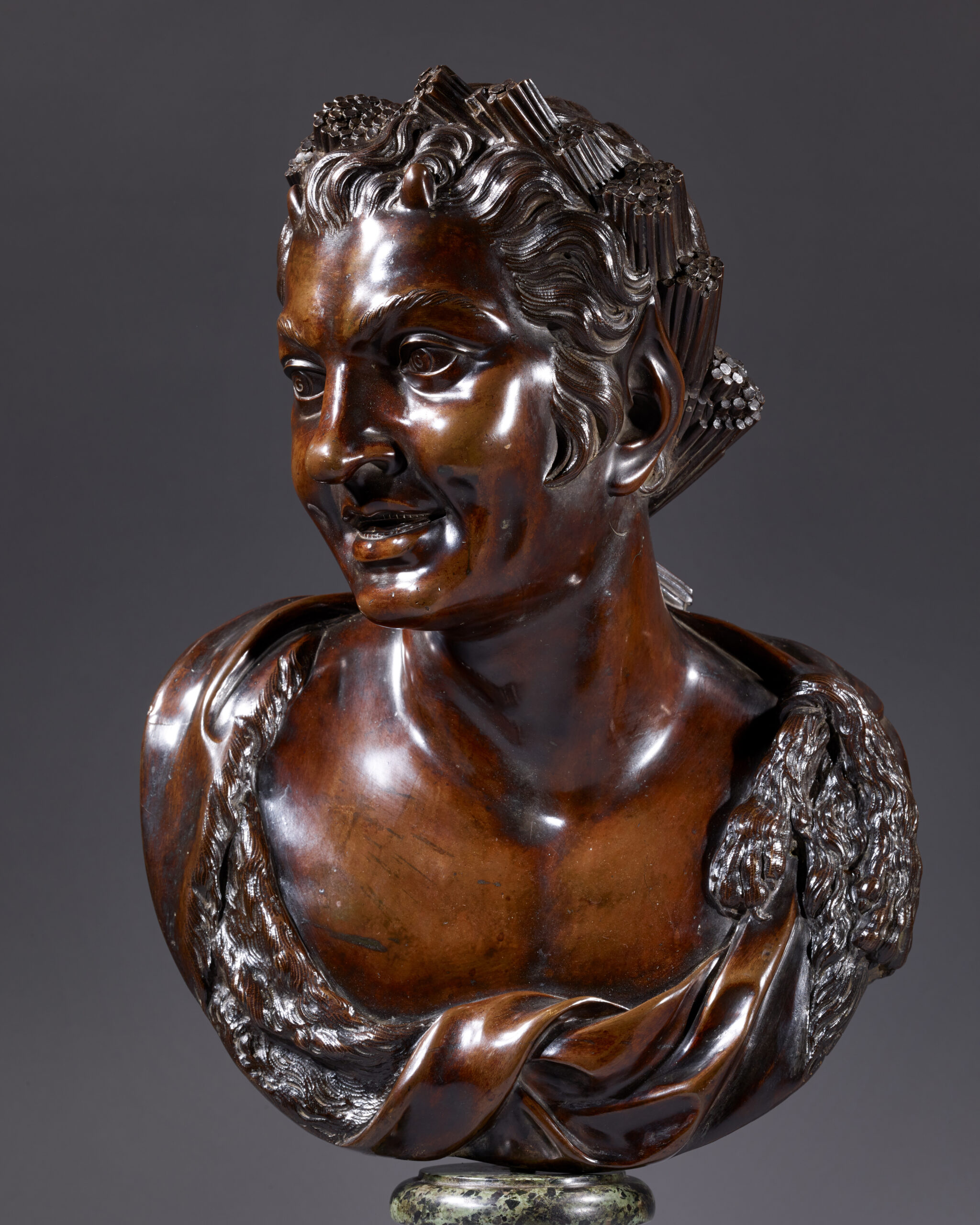
In this instance too, one is prompted to speculate that these busts might not be those of baron de Thiers, since their Egyptian green marble piedouches may well have been replaced by gilded bronze ones between 1782 and 1787. All the above-mentioned auctions were indeed held in succession, and the auctioneers of the Boullongne sale, Georges and Bizet, could very well have described the bust of the faun as being a bust of a satyr instead, as the difference in this case might seem to be a very slight one. On the other hand, it is somewhat harder to imagine Lebrun, who had already owned the models on at least two occasions, using the term incorrectly. It should also be noted that although he described the bust as “very pleasant”, he did not hesitate to use the words “d’après l’antique” (after the antique manner) and “très-bien cifelé” (very well chiselled) to describe the bust of the Faun in his previous sales.
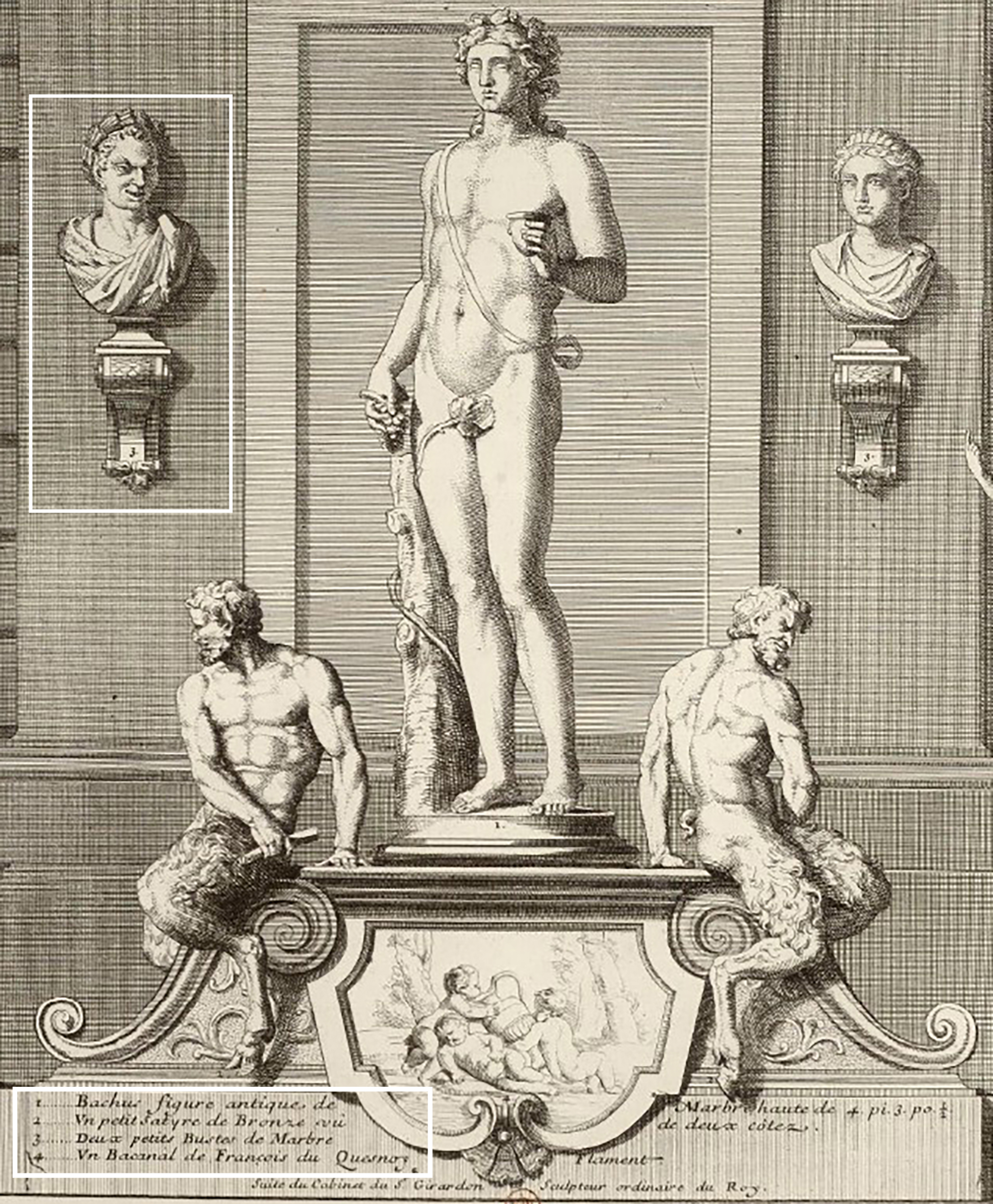
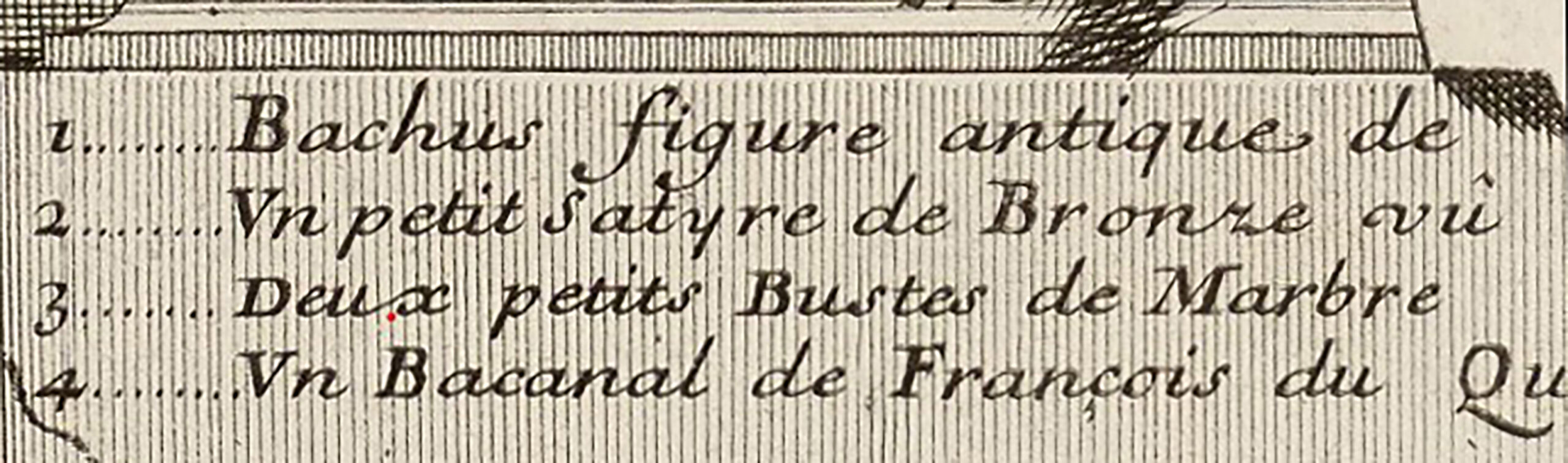
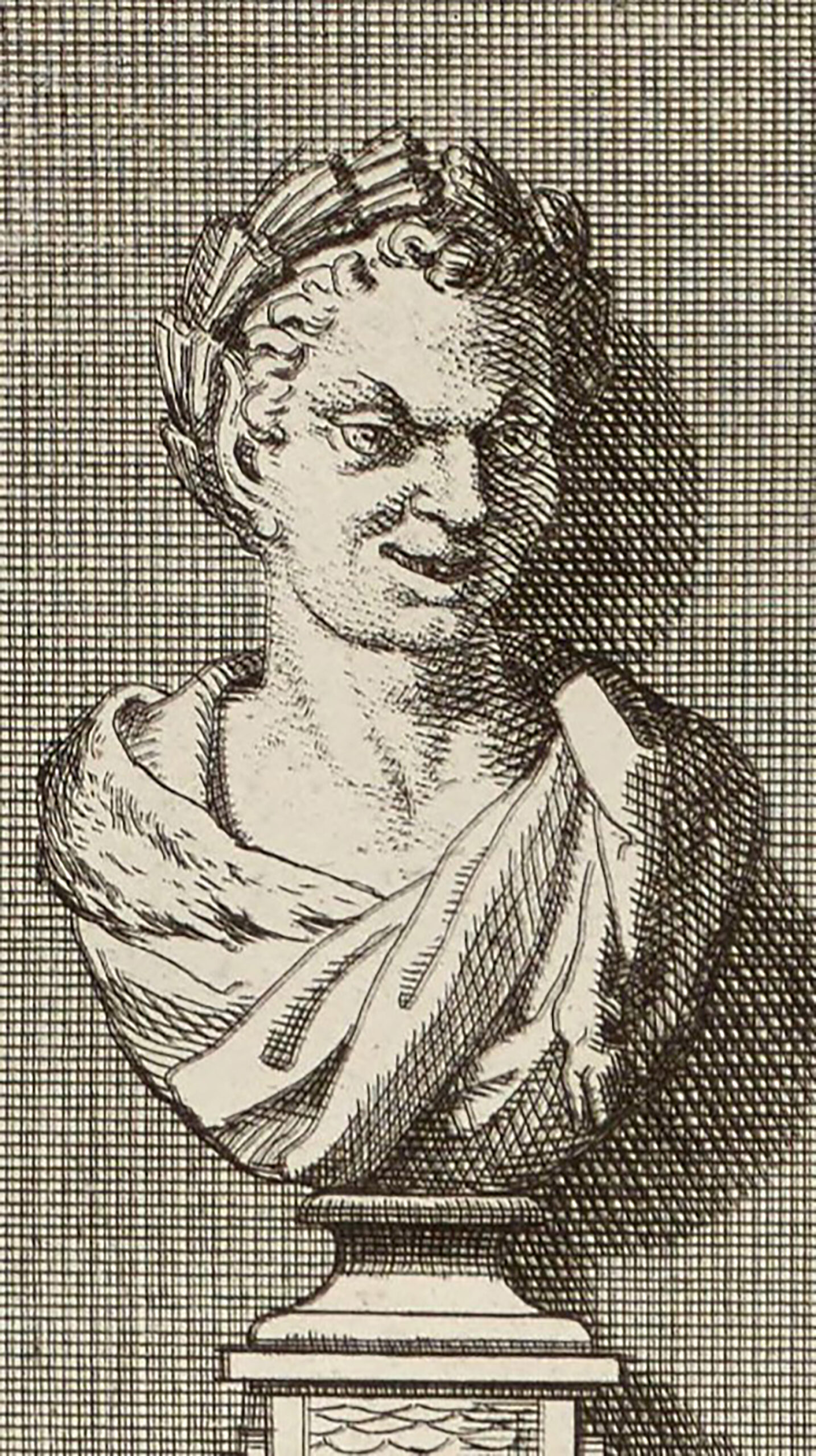
As already mentioned, the model for the bust of the Faun that Le Lorrain most certainly used was an antique head that was part of Girardon’s collection and that he himself made into a bust. This bust, which is reminiscent of the two famous “Mazarin” fauns that were part of the royal collections at the time, could be found in Le Lorrain’s “gallery”, to which he had free access, as a pendant to a bust of a woman in the antique manner, forming figure n°. 3 of plate X of the Gallerie de Girardon, engraved by Nicolas Chevallier after drawings by René Charpentier (1680-1723)], Paris [1709]: “Two small Busts in Marble”. After the sculptor’s death on 1st September 1715, this faun was acquired by Antoine Coypel (1661-1722), Premier peintre du Roi in 1716, who had worked with Girardon on the Louvois Chapel in the Capucines, and was included in his gallery, as revealed in his post-mortem inventory: “In the Gallery: 90. Item, a small marble bust representing a Faun, valued at 30 livres”. His son, Charles-Antoine Coypel (1694-1752), appointed Premier peintre du Roi and director of the Académie royale de Peinture et de Sculpture in 1747, inherited it and kept it until his death.
The bust formed lot n°. 193 of the post-mortem auction of his collection in Paris in April 1753, the catalogue of which was drawn up by Pierre-Jean Mariette (1694-1774):
“193. Bust of a young Faun, antique & white marble, 20 inches high [54 cm. i.e. ten centimetres more than Le Lorrain’s model], not including its piedouche. The carpentry base used to support it shall be sold jointly.” It was bought for 150 livres by Anne Claude Philippe de Pestels de Lévis de Tubières-Grimoard, comte de Caylus (1692-1765), who illustrated it three years later, front and profile, in the second volume of his famous Recueil d’antiquités égyptiennes, étrusques, grecques et romaines, plate XLVIII, figure 1, accompanied by a particularly instructive commentary, p. 140-142: “[…] This beautiful Marble head, & of slightly diminished Natural proportions, was in the Cabinet of Girardon, Sculptor to the King, & of the Académie de Peinture; he placed it on a Bust […] he cast in bronze this Bust, & several others, for M. le Chancelier de Pontchartrain, a man famous for his wit, & for his great talents in the Ministry, who found solace from his important occupations, by seeking out the rarest pieces of the Antique, & the Modern.
These Bronze Busts produce a very nice effect; they could even be misleading in times to come and pass for truly antique pieces. Antoine Coypel, premier Peintre du Roi, acquired this marble at the auction of Girardon’s Cabinet; he considered it to be one of the finest pieces in the magnificent collection that this famous artist had assembled, and which he had engraved. This Bust can thus be seen in its entirety as he had remodelled it. Charles Coypel, son of Antoine, also premier Peintre du Roi, had preserved it with that kind of veneration that true Amateurs have for the masterpieces of Art […] This entire bust, as it was cast in Bronze, is nineteen inches, six lines high [52.8 cm.]; the Antique Head is nine inches, six lines high [25.7 cm.]”.
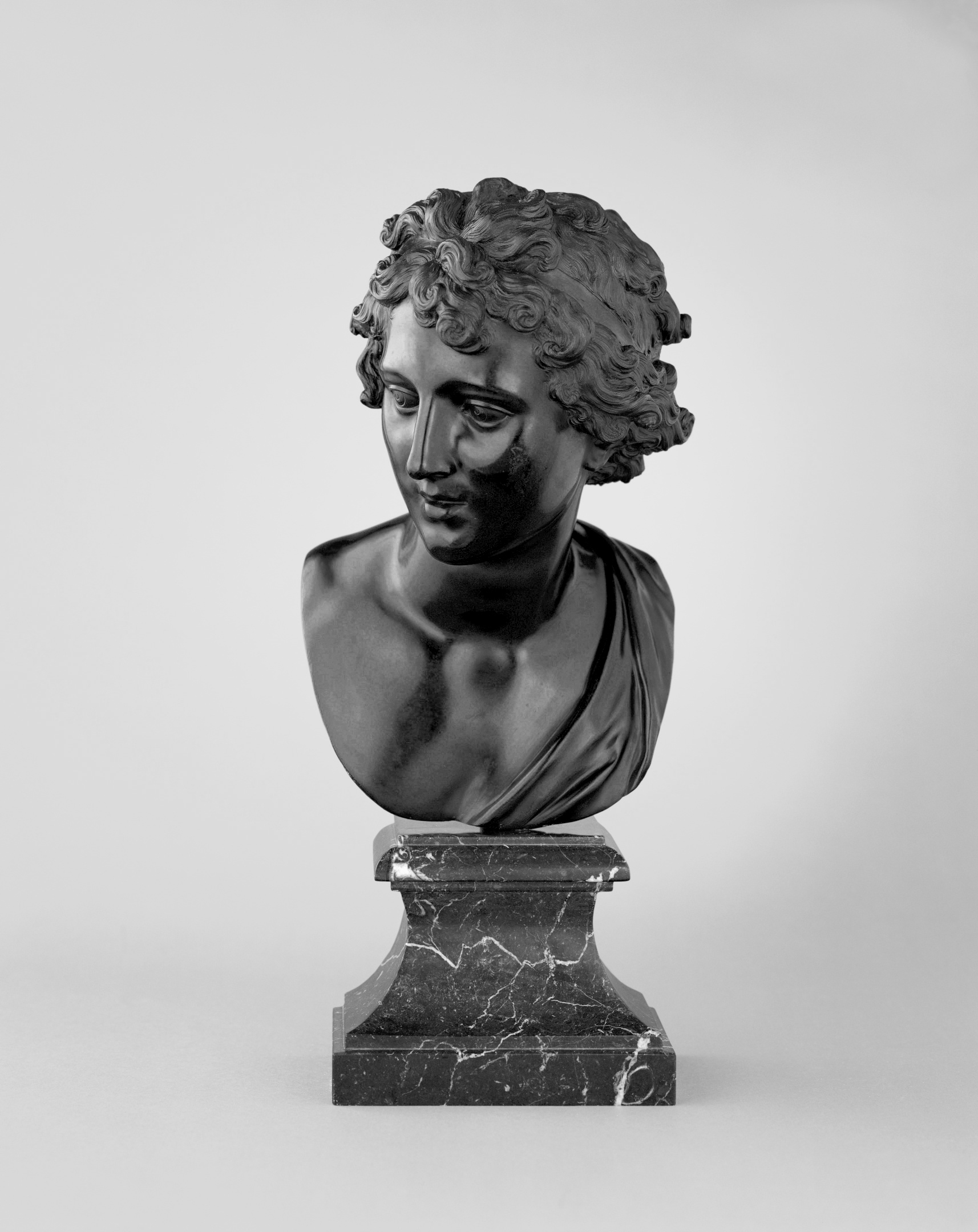
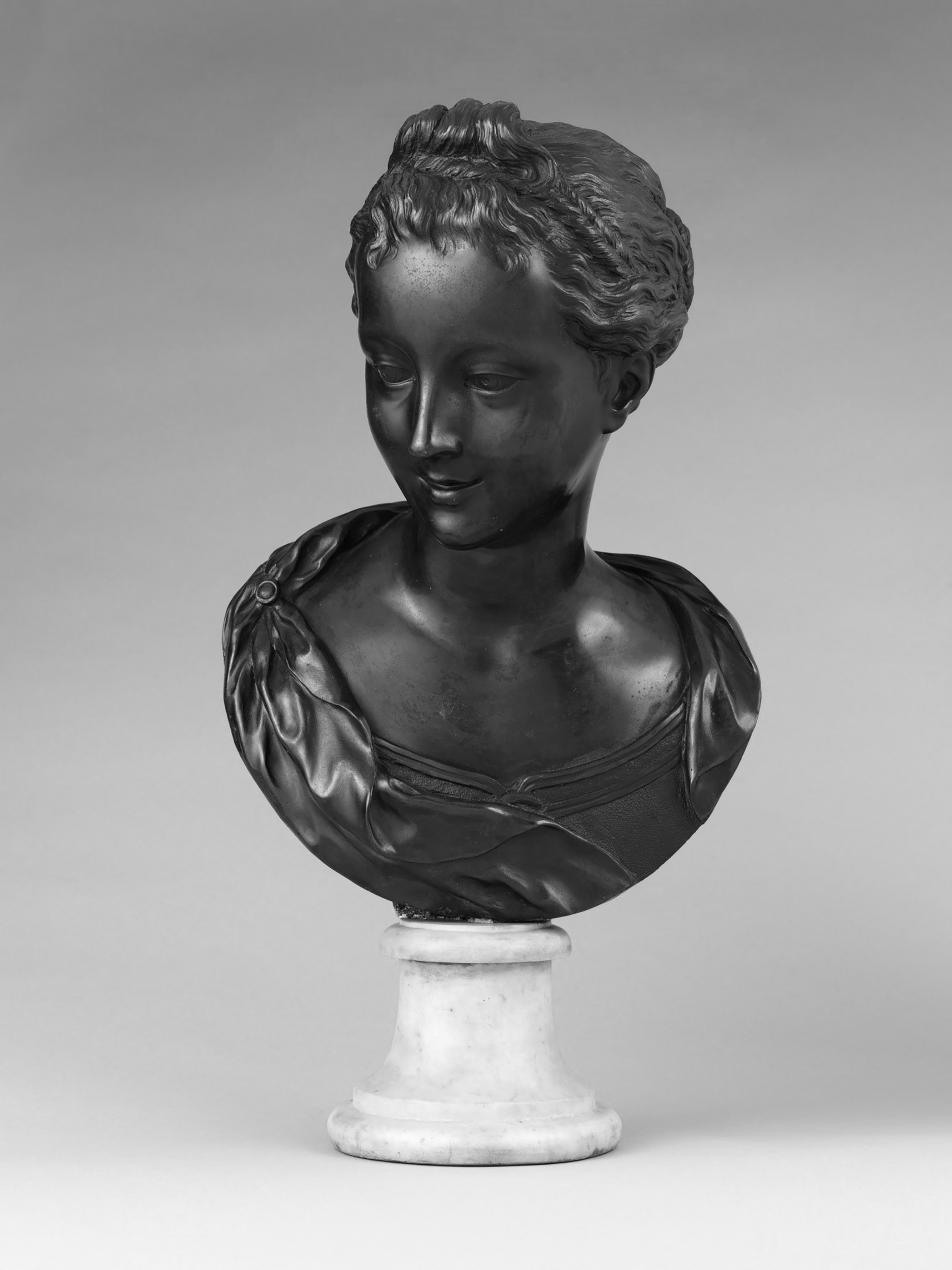
Born in Paris in 1666, Le Lorrain, who had first studied drawing with Pierre Monier (1641-1703), was admitted to Girardon’s workshop at the age of eighteen. After being awarded the first prize for sculpture in 1689, he stayed in Rome from 1692 to 1694, where he displayed a very distinct interest in bronze, preferring to send to Paris, as Dezallier d’Argenville puts it, “models after the antique manner, & some of its compositions” to be cast and sold to private individuals, rather than marble sculptures for the King. Consequently, he was to incur the wrath of Matthieu de La Teulière, director of the Académie de France in Rome from 1684 to 1699, who, in a letter dated 15th June 1694, wrote to Édouard Colbert de Villacerf (1628-1699), surintendant des Bâtiments du Roi: “[…] Mr. Lorrain has every reason to be satisfied with his sojourn, in that he has only worked for his own benefit. He sent most of the models he executed to Paris. I thought they were only intended to demonstrate what he knew how to do, but I have learned that it was to sell them to some caster who will turn them into bronze. He will be able to carry on this trade in Paris more easily than here”.
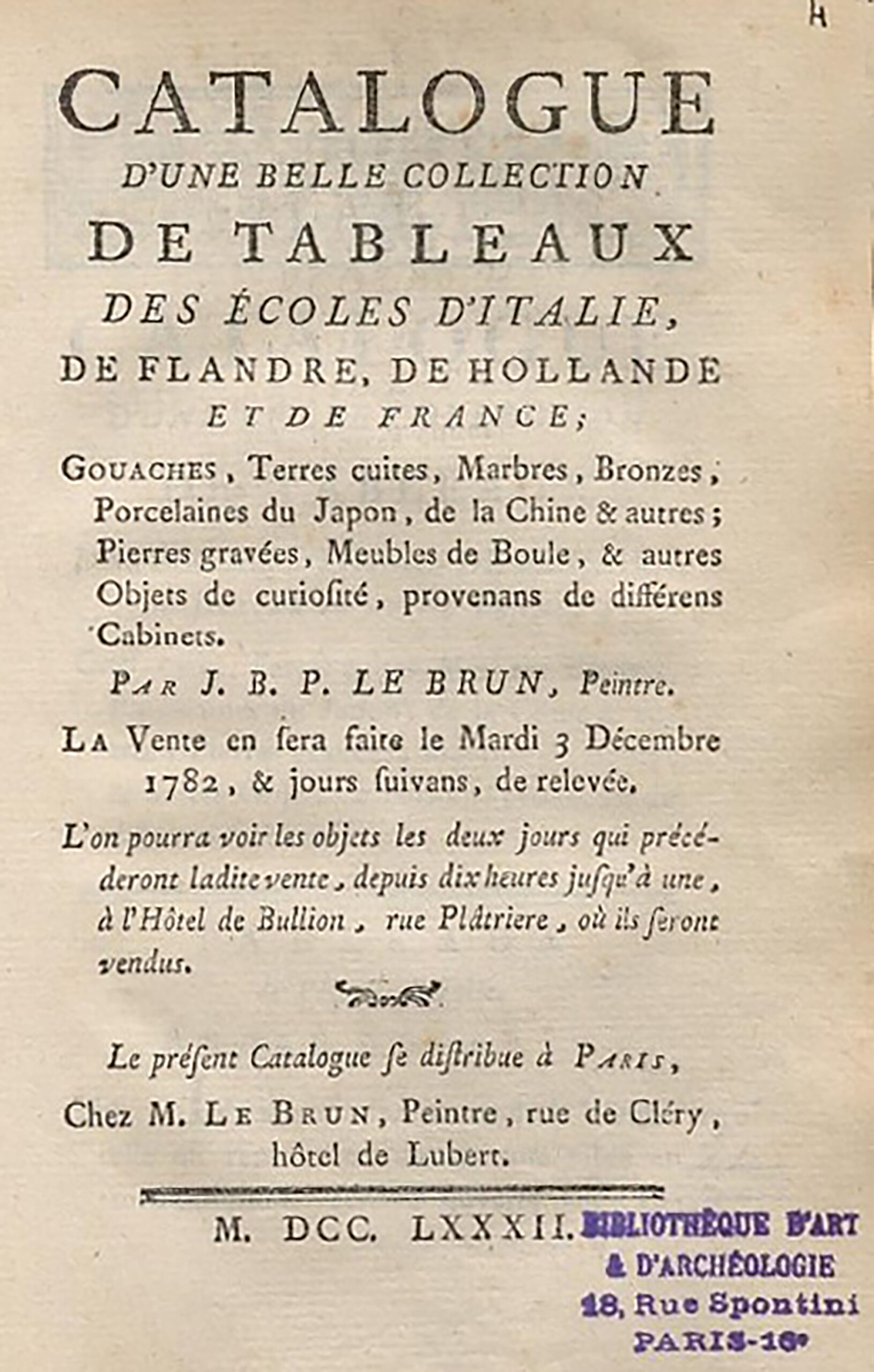
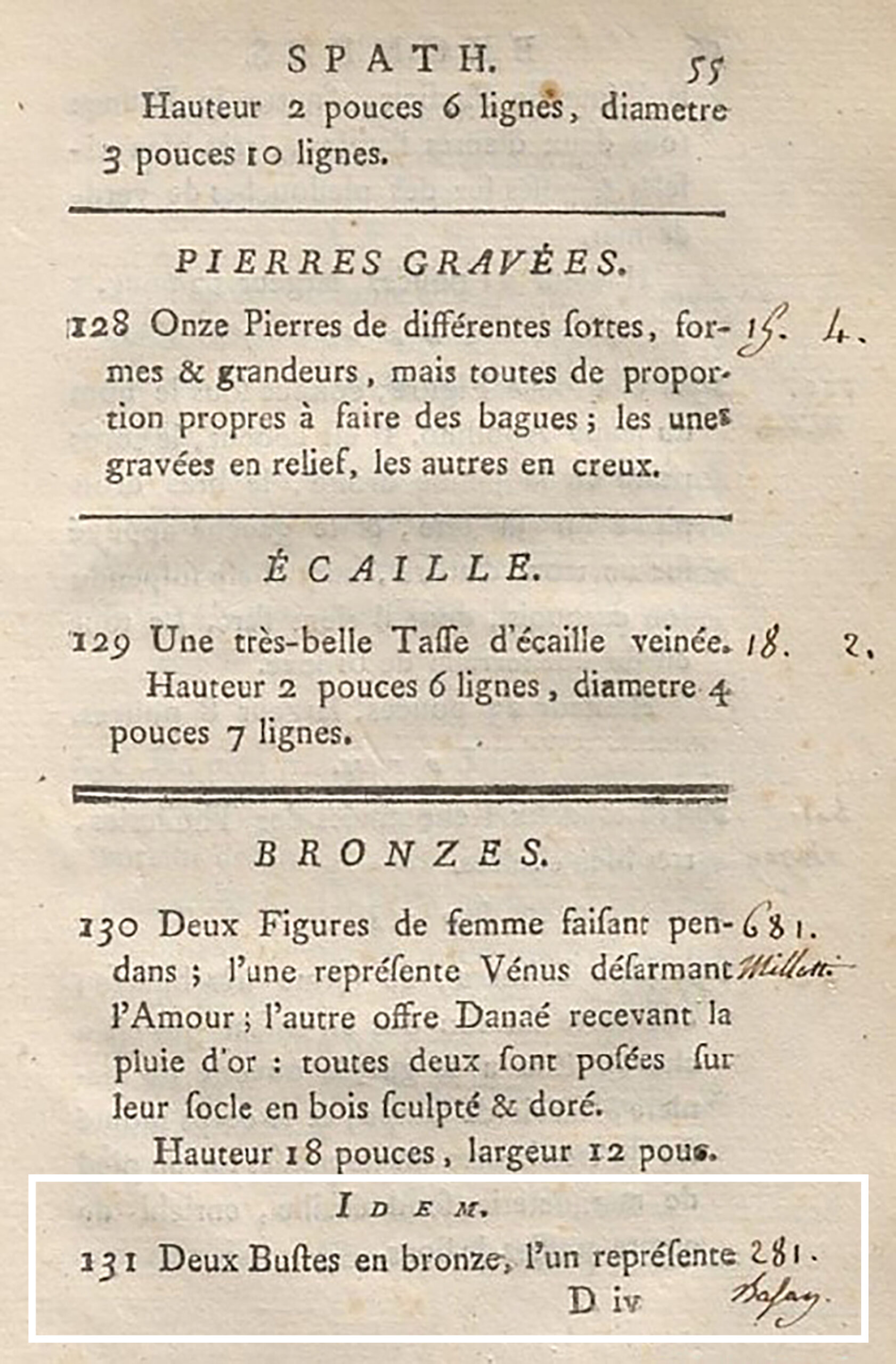
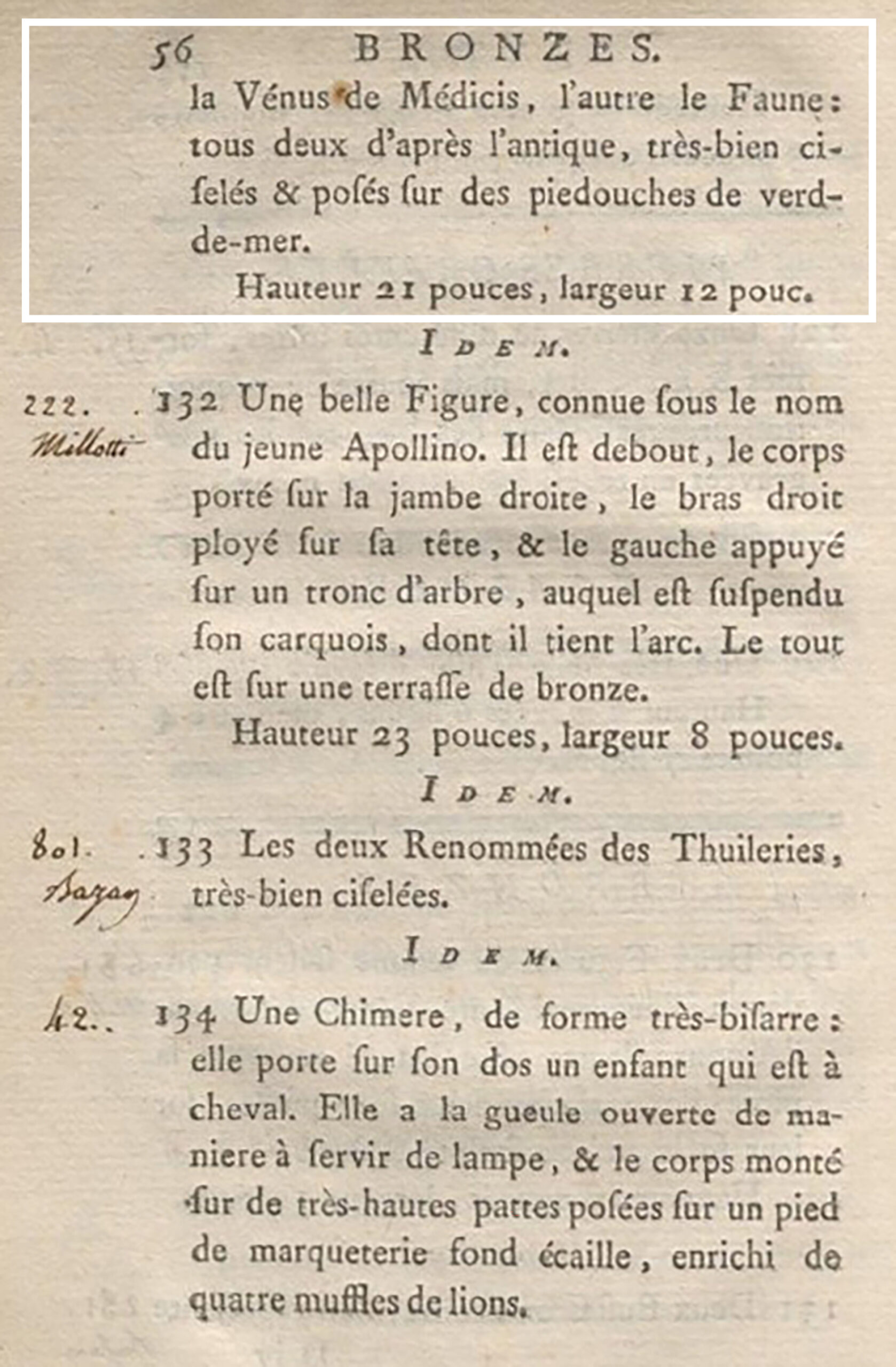
Collection of Jean-Baptiste-Pierre Lebrun (1748-1813) & “provenans de differens Cabinets”,
auction in Paris, by J. B. P. Lebrun, 3rd December 1782 and following days, lot n°. 131.
After returning to France in September 1694, he was accredited in 1700 and the following year admitted to the Académie royale de Peinture et de Sculpture. Between 1695 and 1705, part of his activity was devoted to the creation of several models of Small-scale sculptures destined to be cast in bronze, following in the steps of Corneille Van Clève (1645-1732), whom Le Lorrain greatly admired. According to Mariette, “He modelled with great ease. He was also very busy, especially in his early years, executing models of figures and groups, which were cast in bronze and which adorn cabinets. They are pleasant and lavishly assembled.”
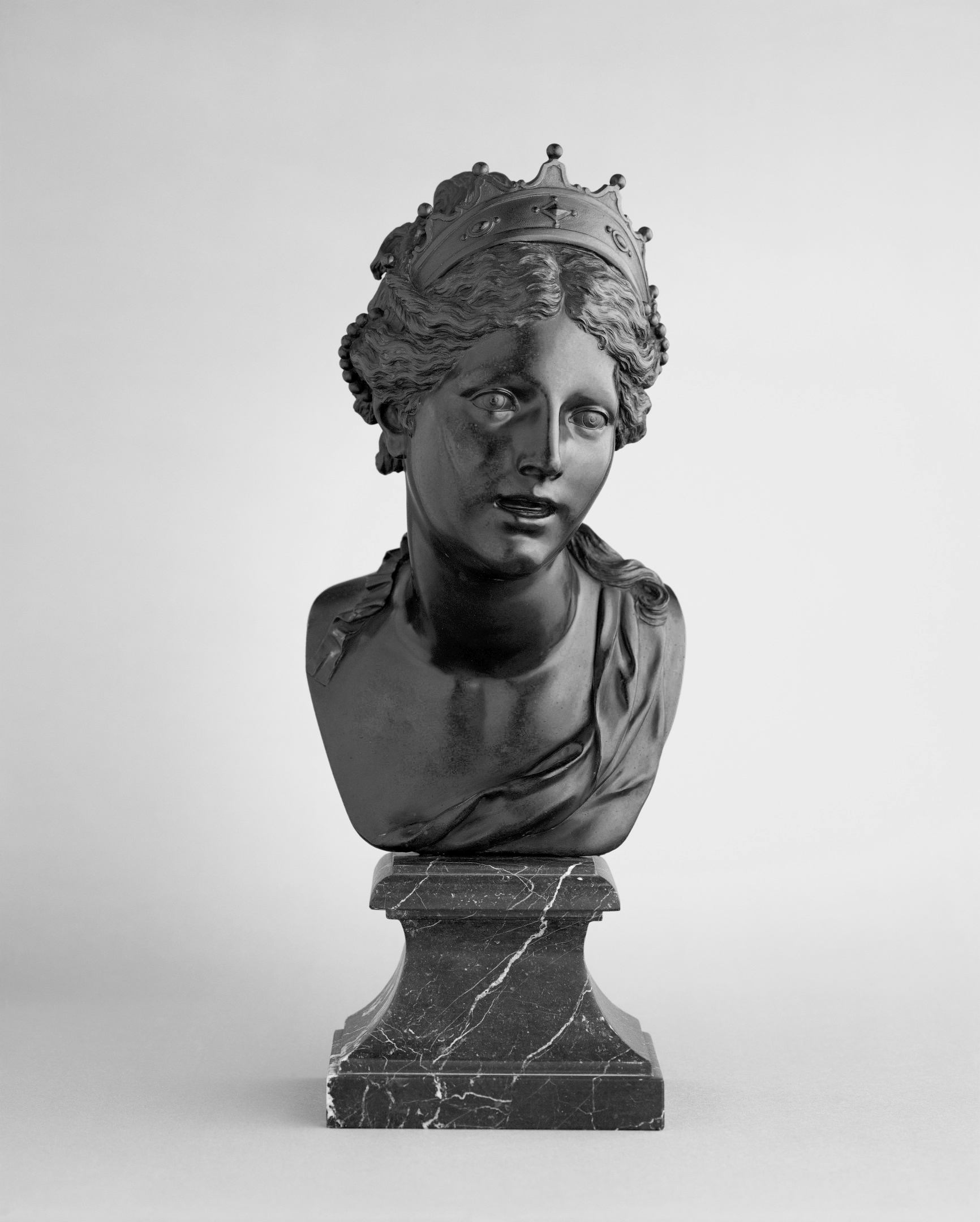
From 1714 onwards, Cressent, who had just arrived in Paris, carried out chiselling work for him as well as for Girardon, as can be evidenced by the mention of an “Andromeda chained to a rock, repaired by Sieur Cressent for M. Le Lorrain, who designed the model”, successively forming lot n°. 91 of the Cressent auction of 15th March 1757, then lot n°. 133 of that of 19th March 1765. Very few examples of these bronze works by Le Lorrain, and especially the busts, have been identified to date. A bust of Thetis, with a pendant bust of Apollo, dated circa 1710-1720 and measuring 43 and 38 cm respectively, from the collection of the duc de Talleyrand at the Château de Valençay, now belong to the collection of the Prince of Liechtenstein; another pair of these busts, but with variations and probably of later date, is kept in Baltimore at the Walters Art Gallery; a bust of a young girl, dated circa 1720 and 48.7 cm high, with its piedouche, is kept in New York at the Metropolitan Museum of Art; The Frick Collection in New York owns a cuirassed bust of a young boy who might symbolise the god Mars, 36.2 cm high, which came from the Rouet de Clermont and then J. Pierpont Morgan collections; it is displayed ‘en pendant’ (as a pendant) to a bust of a young girl based on the model in the Metropolitan Museum; a ‘pair’ of busts similar to those in the Frick Collection, from the collection of Sir Philip Sassoon, belongs to the Huntington Library, Art Museum, and Botanical Gardens, in San Marino; and the same busts “en pendant” were also part of the Louis Guiraud collection in Paris, auctioned in 1971.
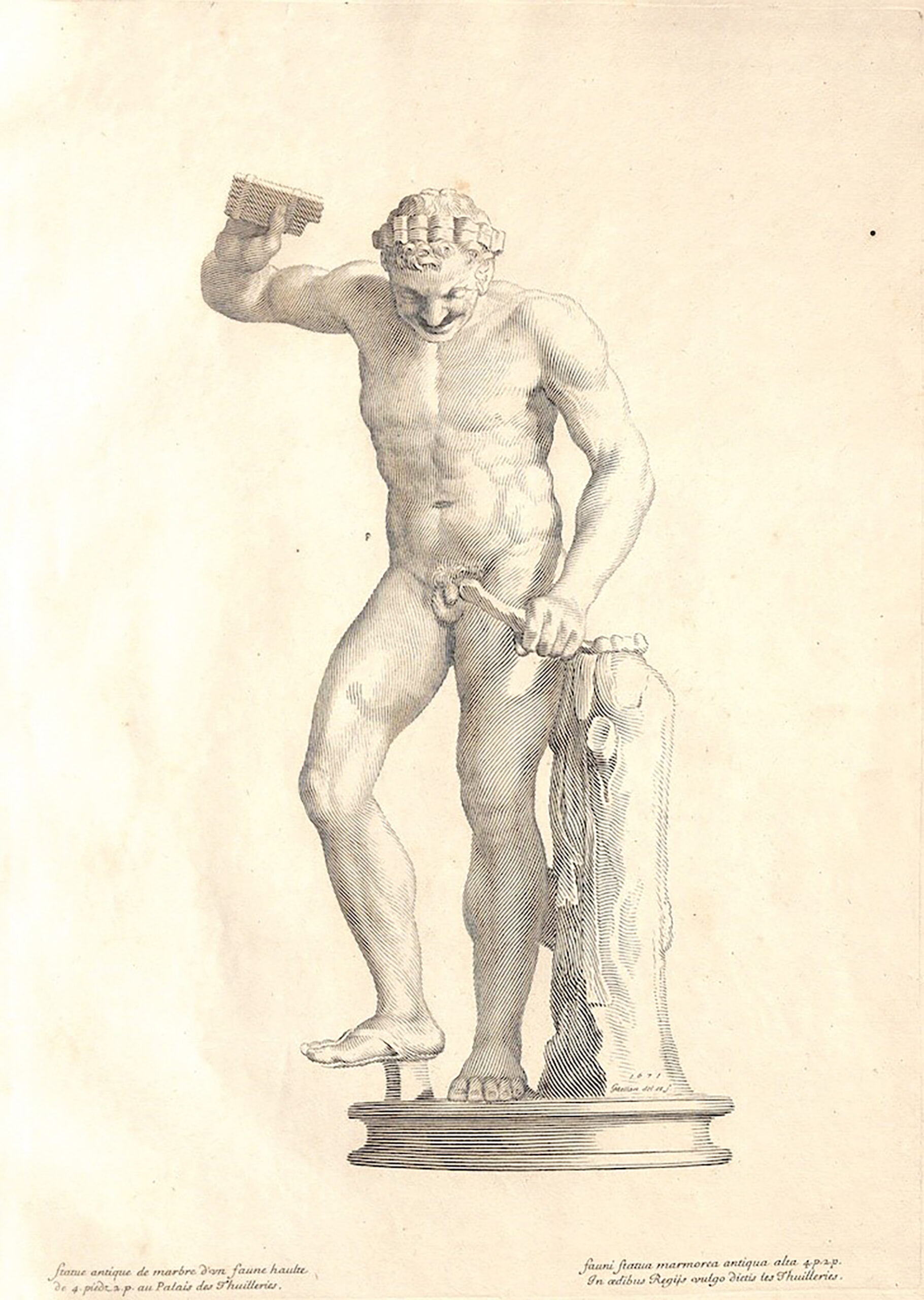
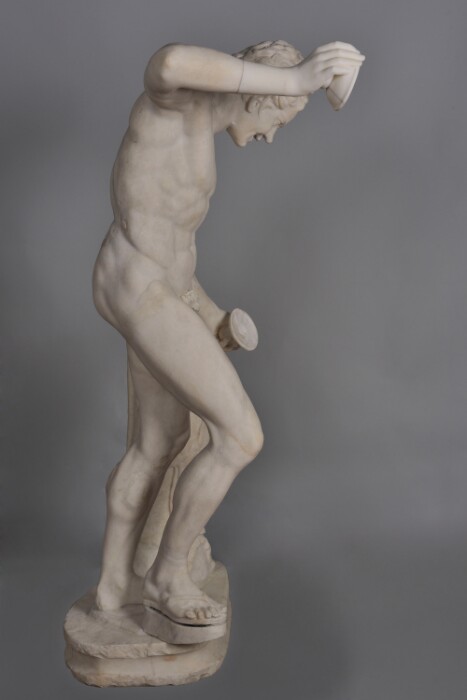
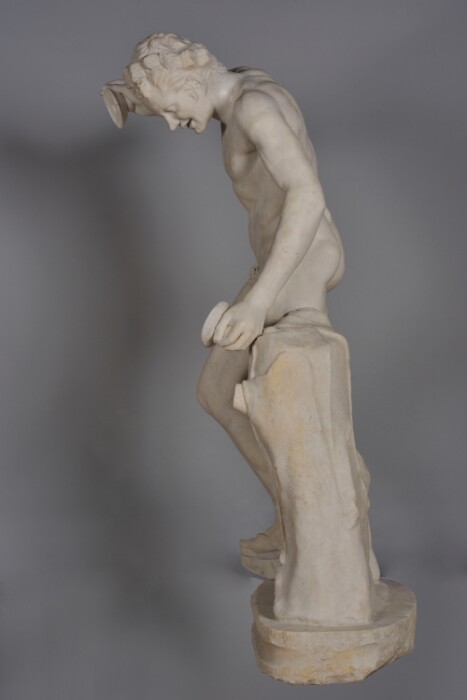
Claude Mellan, Antique marble statue of a faun [Le Faune grec Mazarin], 4 ft. 2 in. high, in the Palais des Thuilleries, 1671. Engraving published in André Félibien, Tableaux du Cabinet du roy. Statues et bustes antiques des maisons royales, vol. I, 1677.
Versailles, Musée national des châteaux de Versailles et de Trianon, A13-133, pl. 9.
Le Faune grec Mazarin, bust in the antique manner after a 2nd century original, discovered in the 1630s in Rome, near the basilica of the Santi Quattro Coronati, with another Faun (MR 1918).
Collection of the Château de Versailles (inv. MR 1917/MV 7959).
In view of this particularly limited corpus, since many works have either disappeared or could never have been identified, the attribution of these busts of the Venus de’ Medici and the Faun to Le Lorrain comes as an important discovery, particularly the model of the Faun, which was traditionally ascribed to Soldani-Benzi. The subject of the Faun was treated on several occasions by Le Lorrain—in 1706-1710, he executed a marble Faun of about 1.60 metres, now lost, for the cascade at Marly; it is perhaps the model of this Faun that is mentioned in his workshop in his post-mortem inventory drawn up on 6, 7 and 8 August 1743; “A Faun & a Dryad, busts en pendants [in white marble], by Robert Le Lorrain […] height of each 18 inches [48.7 cm. ] not including feet of black marble [… ]” were part of the auction of the collection of Augustin Blondel de Gagny (1695-1776), on 10th December 1776 (lot n°. 406); according to Michèle Beaulieu, there seems to have been at least three versions of these two “pendants” in white marble, none of which has been identified to date; finally, Le Lorrain also received 575 livres, on 25th March 1708, for two bronze figures, also unidentified and intended for the grand salon of the Hôtel de Condé: an Apollo and the “Antique Faun Holding the Infant Jupiter” executed after the famous antique from the Borghese collection, which entered the Louvre in 1807.